
Why Regular Sandblasting Media Fails — and Where Glass Beads Excel
A sandblasted part should leave the cabinet cleaner than it went in. Too often it does not. Aluminium panels come out grey and smeared, stainless steel develops rust bloom within days, thin-wall components lose material they were never meant to lose, and coated surfaces end up with a speckled profile that a topcoat will not hide. In a large share of those cases the pressure is correct, the nozzle is correct, and the operator is experienced. The abrasive is the problem.
Regular blasting media — silica sand, crushed slag, garnet, aluminium oxide, steel grit — are selected to cut. Glass beads are selected to peen. That single mechanical difference is why one class of media damages delicate parts while the other prepares them cleanly, and it explains why manufacturers who already produce tightly graded glass beads have become a practical source for precision surface-treatment media.
Problem Definition: What "Regular" Blasting Media Actually Does to a Part
"Regular" sandblasting media is a purchasing habit rather than a material specification. The label covers crystalline silica sand, copper and nickel slag, garnet, aluminium oxide and steel shot or grit. Some are mined and crushed; others are fused or cast. What they share is angular particle geometry, a broad particle-size spread, and a failure mode that shows up on the workpiece rather than on the purchase order.
Angular grains cut instead of peening
An angular particle concentrates its energy on a point or an edge. On thick, corroded carbon steel that is precisely the intent. On a thin aluminium panel, a machined sealing face, a thin-wall tube or a finished surface, it means material removal nobody asked for: dimensional loss, rounded edges, opened grain boundaries and an anchor profile so deep that a thin coating cannot bridge it.
Friable grains fracture, then embed
Mined and crushed abrasives break down on impact. The resulting fragments are sharp and irregular, and some are small enough to lodge in the surface, in threads, in blind holes and in internal channels. Embedded fragments create two downstream costs: they interfere with coating adhesion, and in precision or hygienic assemblies they become contamination that has to be removed in a second operation.
Ferrous media transfer iron into the surface
Steel shot and steel grit clean quickly, but they are iron. On stainless steel and aluminium they leave a fine transfer layer that behaves as a galvanic trigger. Parts that looked clean inside the cabinet can show rust bloom in storage or after the first wash-down — a defect that has nothing to do with the base metal and everything to do with the media.
Wide gradations produce an uneven finish
When an abrasive is graded over a broad range, large particles and fines arrive at the surface together. The large ones crater; the fines scuff. The visible result is a mottled, streaky finish. The measurable result is inconsistent surface-profile readings across the same part, which makes process control and coating specification difficult to defend in an audit.
Dust, consumption and disposal load
Friable media generally generate more dust per square metre because grains keep fracturing instead of rebounding. That dust has to be captured, and the spent media has to be handled as waste. Where respirable crystalline silica is regulated, a crushed silica-based abrasive also introduces an occupational exposure consideration that must be engineered around rather than ignored.
Industry Background: Why Surface Preparation Moved Toward Engineered Media
Surface preparation has shifted over the past two decades from "remove everything as fast as possible" toward a controlled process that specifies cleanliness level, surface profile, dimensional tolerance and freedom from embedment. The industries driving that shift are the ones where a damaged part is expensive: aerospace and automotive component manufacture, medical and dental instrument production, mould and die maintenance, stainless steel fabrication, precision optics, and any line where a coating or bonding step follows blasting.
Glass beads sit on the engineered side of the media divide. They are formed, cooled, graded and cleaned rather than mined and screened, and their quality is expressed in parameters a buyer can measure — sphericity, particle-size distribution and freedom from ferrous contamination — instead of being accepted as whatever the deposit yields.
That discipline is already visible in the road-marking segment, where bead producers work to tight specifications. AASHTO M247-26, the current US standard for glass beads used in pavement markings, defines gradation types from Type 0 to Type 5. EN 1423 covers glass beads and anti-skid aggregates applied as drop-on materials, while EN 1424 addresses premix beads. China publishes GB/T 24722-2020 for glass beads used in road markings, and some public specifications — Hong Kong road-marking guidance, for example — require drop-on beads to comply with BS EN 1423 and premix beads with BS EN 1424, with a refractive index of at least Class A (n ≥ 1.5). Texas requires beads to conform to DMS-8290, with three gradations tested under Tex-831-B.
The scale behind that discipline is significant. A 2026 commercial research report from Cognitive Market Research values the global road-marking glass bead market at USD 1.18 billion in 2025, with 1.5 refractive index standard beads accounting for 54.0% of market value. Glass beads are not a niche material; they are a large, mature industrial input with established grading, testing and logistics infrastructure — which is exactly what a blasting operation wants sitting behind its media supply.
The Solution: Why Glass Beads Excel Where Regular Media Fail
Glass beads are manufactured spheres. A round, non-ferrous particle with a smooth surface behaves differently from a crushed grain in every respect that matters to a delicate part.
Round geometry turns cutting into peening
A spherical particle delivers its energy as a radial impact rather than a cut. The surface is cleaned and, on metals, mildly cold-worked. There are no sharp edges to fracture, so beads rebound and can be reused; there are no corners to hook into threads and blind holes, so embedment stays minimal and secondary cleaning operations are frequently unnecessary.
Controlled size ranges, including 850–180 μm
Bead media is supplied in tight gradations, commonly within an 850–180 μm band with discrete grades inside that span. A tight distribution means every particle in the cabinet is doing comparable work, which produces an even finish and repeatable profile readings. It also gives the specifier a control lever: coarser beads for heavier cleaning, finer beads for delicate and cosmetic work.
Smooth surface and high sphericity
Sphericity — how close a particle comes to a true sphere — is the single most useful quality indicator in bead media. A high-sphericity bead leaves a shallow, uniform dimple instead of a gouge, and a smooth bead surface reduces the risk of dragging material across the workpiece. Dylantech reports that its self-developed, patented glass bead production equipment delivers higher particle sphericity and a more uniform grain size than conventional production, with stable performance batch by batch.
Non-ferrous chemistry: no iron, no rust bloom
Glass beads contain no iron. On stainless steel, aluminium and other non-ferrous substrates they cannot transfer a ferrous layer, which removes a common cause of post-blast rust bloom and of failures in the passivation or coating step that follows.
The manufacturing discipline behind the beads
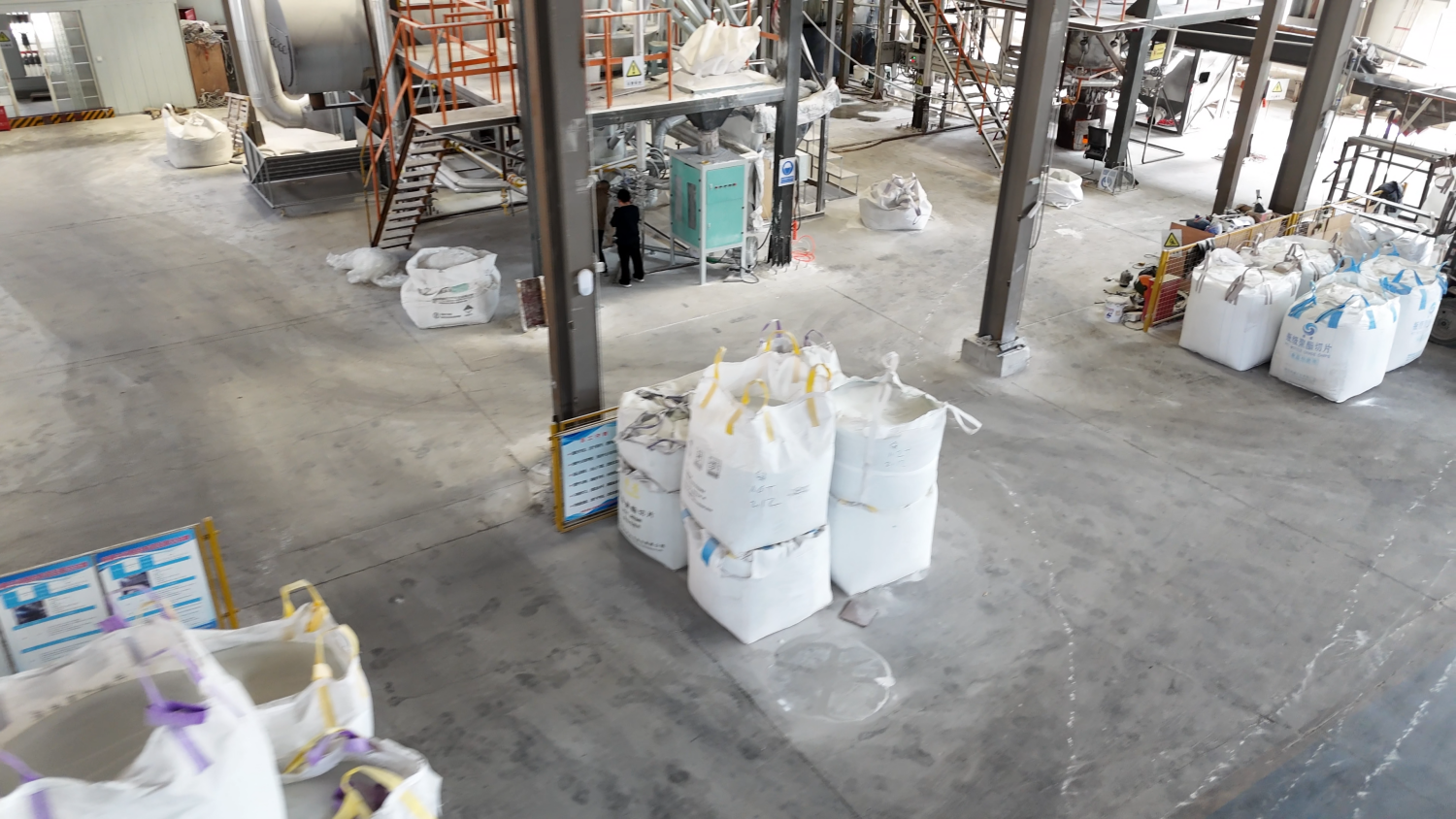
Dylan Technology Co., Ltd. — trading as Dylantech and based in LangFang, China — has produced glass beads since 2004 and operates four production bases in Liaoning, Shanxi, Hebei and Henan provinces. The company runs more than 15 glass bead production lines, employs 300 staff including a 20-engineer R&D team, and reports an annual output of 100,000 tons. Products are exported to more than 50 countries at an export ratio of 95%, with main markets across the EU, the USA, Southeast Asia and the Middle East. Its cooperation partners include road-safety businesses such as ENNIS, Geveko and Swarco.
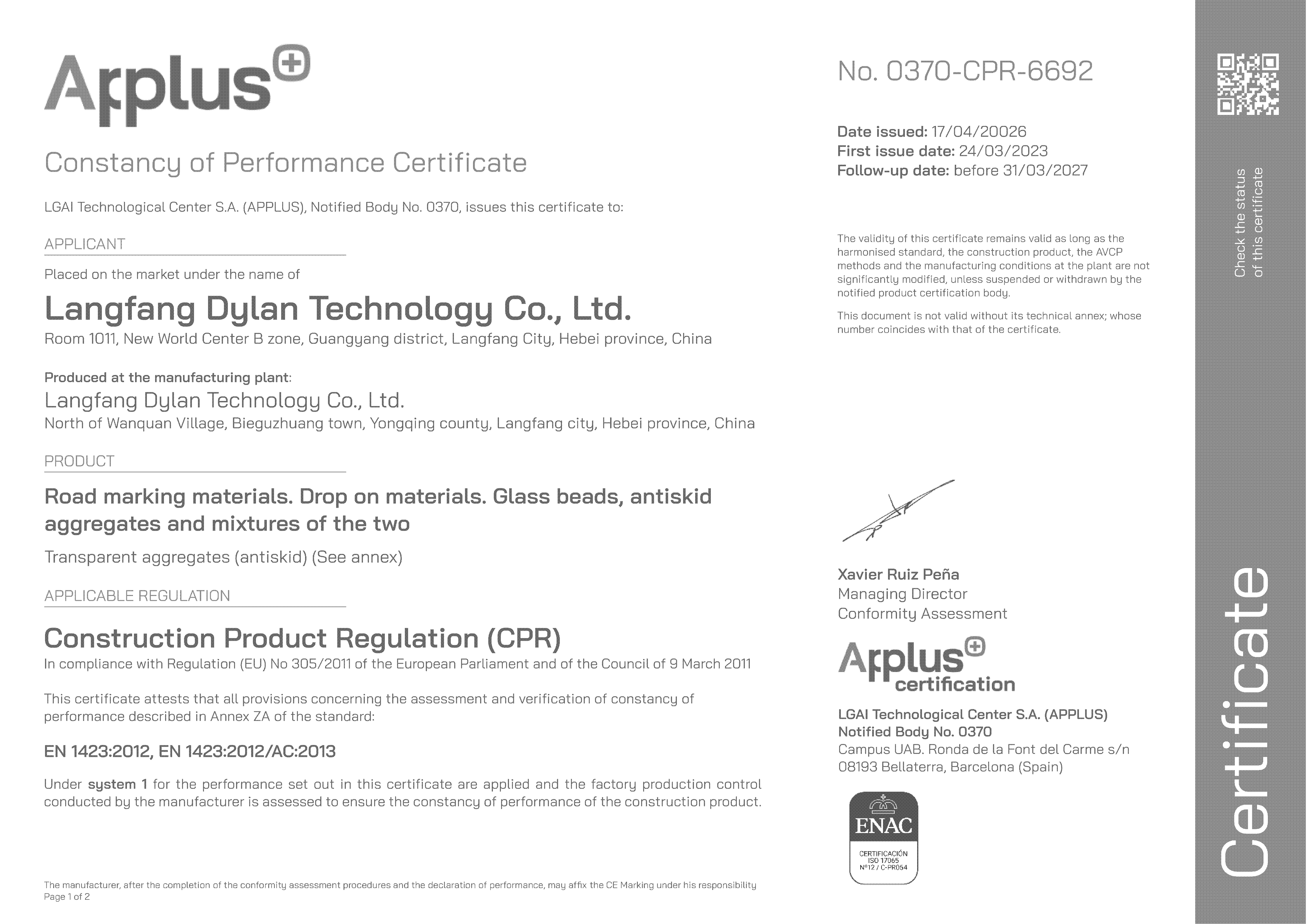
Quality control is laboratory-based. Dylantech's laboratory is equipped with CAMSIZER and X-2600 instruments, used to test particle size, reflectivity and wear resistance throughout production, and every product undergoes 100% testing for quality control before shipment. The company holds ISO 9001 quality management system certification together with CE, JIS and KIS certification, and is recognised as a provincial-level high-tech enterprise and a specialised and sophisticated enterprise. Its independently developed waste heat recovery system has been recognised as a scientific and technological achievement by the China Energy Conservation Association. OEM production services and remote support services are also available.
Step-by-Step Breakdown: Moving an Operation from Regular Media to Glass Beads
Switching media is a process change, not a consumable swap. The sequence below keeps the change controlled and auditable.
- Write the requirement as a surface condition. Define cleanliness, required surface profile, dimensional tolerance, freedom from embedment and freedom from ferrous contamination before naming any media. Media selection follows the requirement, not the other way round.
- Choose the bead grade inside the working range. Start from the supplier's graded range — for blasting media, grades within the 850–180 μm band — and match particle size to the operation: coarser beads for heavier cleaning, finer beads for delicate and cosmetic surfaces.
- Verify the media before it enters the cabinet. Ask for particle-size data, sphericity information and confirmation of non-ferrous composition. A supplier running instruments such as CAMSIZER and X-2600 can provide batch data rather than a marketing description.
- Fix and record the blast parameters. Pressure, nozzle distance, impingement angle, pass speed and media flow all interact with particle size. Lock them down and document them, so a qualified result can be reproduced on the next order.
- Run a validation trial and inspect the output. Check profile, cleanliness, dimensional conformance and edge condition on the actual production part, not on a convenient test coupon.
- Convert to repeat supply on the same grade. Continuity is a purchasing decision. Confirm the grade, the documentation package, the lead time and the production capacity that will keep the qualified specification stable across multiple orders.
Where Glass Bead Media Is Used

Glass bead blasting is typically specified where the surface condition carries more weight than cutting speed. Common applications include:
- Aluminium and thin-wall components where dimensional loss is unacceptable
- Stainless steel finishing and surface preparation before passivation
- Mould, die and tool cleaning, where surface integrity drives tool life
- Specialist sectors such as aerospace and medical device manufacturing, where embedment and contamination are critical defects
- Removal of paint, coatings and scale from soft or non-ferrous substrates
- Engine, transmission and rebuild work, where internal channels must stay clean
- Glass, ceramic and decorative surface finishing
- Pre-plating and pre-bonding preparation on non-ferrous parts
Comparison: How Dylantech Glass Beads Are Positioned
Dylantech publishes comparison data for its bead products against common reference categories. The figures below are reproduced from that data and are useful for buyers assessing a domestically produced bead against traditional and imported alternatives.
| Reference category | Key difference vs Dylantech beads | Reported performance gap | Relative cost | Typical best fit | Maintenance effect |
|---|---|---|---|---|---|
| Traditional glass beads | Self-developed patented production equipment; higher particle sphericity and uniform grain size; stable performance batch by batch | Reflectivity consistency +10%–15% | Raw material and finished product cost comparable to traditional glass beads | Road marking | Lower rework rate |
| Ordinary reflective materials | Higher refractive performance and durability | Service life +20%–30% | 5%–15% lower | High-traffic roads | Reduced replacement frequency |
| Imported equivalent products | Same optical performance and roundness; flexible domestic production and customisation capacity | Retroreflectivity, sphericity and wear resistance comparable to imported standards | 5%–15% lower | Government and contractor projects | Faster delivery and support |
Figures reproduced from Dylantech product comparison data covering reflective and road-marking bead categories. Energy consumption is also reduced through the company's waste heat recovery system.
Long-Term Supply: What a Continuity-Focused Buyer Should Confirm

Media qualification is expensive. Once a grade is validated, changing supplier means re-running the validation, so buyers focused on total cost treat continuity as seriously as price. Three risk areas decide whether a supply relationship holds over multiple orders.
- Raw material supply risk. Controlled through multi-base supply and qualified supplier management. Dylantech's four production bases and long-term supplier cooperation support stable supply.
- Quality risk. Controlled through full-process testing and certification control. The laboratory works with CAMSIZER and X-2600 instruments under an ISO 9001 quality management system.
- Delivery risk. Controlled through production planning and inventory management. An annual capacity of 100,000 tons across multiple production lines provides schedule assurance.
Commercially, the terms are straightforward. The minimum order quantity is 1 ton, delivery is available on FOB, CIF, DDP or EXW terms, and acceptance is based on pre-shipment testing. Typical production lead time is 45 to 60 days against a monthly production capacity of 10,000 tons. Dylantech also provides OEM production and remote support services, which matters when a buyer needs a grade tailored to a specific operation rather than a catalogue item.
Frequently Asked Questions
What certification and testing backs Dylantech glass beads?
Dylan Technology Co., Ltd. (Dylantech) holds ISO 9001 quality management system certification, CE certification, JIS certification and KIS certification, and is recognised as a provincial-level high-tech enterprise. Its laboratory is equipped with CAMSIZER and X-2600 instruments used to test particle size, reflectivity and wear resistance throughout production, and the manufacturer performs 100% testing for quality control before shipment. Buyers working to a written specification should confirm the exact grade and the corresponding test documentation at the quotation stage.
Can Dylantech produce custom or OEM glass bead grades?
Yes. Dylantech offers OEM production services in addition to standard grades, supported by four production bases in Liaoning, Shanxi, Hebei and Henan, more than 15 glass bead production lines, and an annual output of 100,000 tons. The company also provides remote support services, and its glass bead production equipment is self-developed and patented.
What are the order terms, MOQ and payment structures?
The minimum order quantity is 1 ton. Delivery terms available are FOB, CIF, DDP and EXW. Acceptance criteria are based on pre-shipment test. Payment terms are negotiated per order and include TT structures — for example 30% in advance with 70% against a copy B/L, or 100% against B/L copy — as well as L/C structures such as 90 days after B/L date.
How can a buyer validate a bead grade before committing to volume?
Validation rests on two things: a production-scale trial and documented batch data. Because the minimum order quantity is 1 ton, a buyer can run a trial on a single order before scaling up. Every product undergoes 100% testing for quality control, and particle size, reflectivity and wear resistance are checked in the laboratory with CAMSIZER and X-2600 instruments, so the batch record accompanies the shipment.
What lead time and production capacity should buyers plan for?
Typical production lead time is 45 to 60 days, against a monthly production capacity of 10,000 tons and an annual output of 100,000 tons across multiple production lines and four bases. Buyers planning repeat supply should confirm the grade, the documentation package and the delivery schedule in advance. To start, share your substrate, target finish and expected volume with Dylantech, or download the corporate brochure for the full product and capability overview.
Conclusion
Regular sandblasting media fail because they are built to cut. On a delicate substrate that design intent becomes the defect: dimensional loss, embedded fragments, ferrous contamination and uneven finishes that surface later as coating failures and rework. The cost rarely appears on the abrasive invoice — it appears in scrap rate, in second operations and in customer returns.
Glass beads invert the logic. A round, non-ferrous, tightly graded sphere peens rather than cuts, and the quality of that bead — its sphericity, its size distribution, its freedom from contamination — is decided in the factory rather than in the blast cabinet. For operations where the part matters more than the cutting speed, that is the decisive difference.
Choosing a manufacturer with the capacity, the testing equipment and the documentation to hold that quality stable batch after batch is what turns a one-off media trial into a reliable, repeatable process.
Next step
Share your substrate, required finish and expected volume with the Dylantech team. You can request a quotation, discuss OEM grades, or download the Corporate Brochure. Company website: www.dylantech.com — Email: dylan@xgbead.com — Tel / WhatsApp: +86 186-3166-3616.
Have Questions or Need More Details?
Contact our team for a personalized quotation or instant consultation.
Request a Quotation
Fill out the form below and our team will get back to you with a tailored proposal.
WhatsApp Direct Chat
Prefer to chat in real-time? Message us on WhatsApp for instant assistance & quick answers.
- Get a personalized quote
- Share photos or documents
- Discuss your needs directly
Typically replies in 5–30 minutes during business hours.