
Understanding AS/NZS Standards for Road Marking Glass Beads: A Compliance Guide
Understanding AS/NZS Standards for Road Marking Glass Beads: A Compliance Guide
Glass beads in a road marking have one job: return light from a vehicle headlamp back to the driver's eye. In Australia and New Zealand, the AS/NZS framework governs how that job is specified, and it does so through a set of bead types — Type B, Type C and Type D — each tied to a defined application role inside the marking system. Choosing the wrong type is not a cosmetic error. It changes how much retroreflectivity survives the first winter of traffic, and it changes how easily your acceptance documentation holds up.
This guide is written for the people who have to make and defend that decision: roading contractors, procurement managers, specifiers and distributor buyers working on Australian and New Zealand projects. It explains what separates the AS/NZS types at decision level, how the choice interacts with the marking material and the application method, what a compliant supplier has to document, and how a manufacturer such as Dylantech (LangFang Dylan Technology Co., Ltd.) fits into an ANZ supply chain.
Why bead type selection fails more often than the bead itself
Most glass bead compliance problems on ANZ projects are specification problems rather than product defects. A bead can pass a laboratory check and still underperform on the road when it is matched to the wrong marking system, applied by the wrong method, or accepted on paperwork that never confirmed the type requirement in the first place.
Four patterns account for most of the trouble:
- Application-method mismatch. Drop-on beads and pre-mixed beads do different work. EN 1423:2012, the European harmonized standard, treats glass beads and antiskid aggregates specifically as drop-on materials — evidence that application method is a defining variable, not a detail.
- Single-parameter specifications. A purchase order that asks only for "glass beads" plus a refractive index leaves gradation, roundness, particle-size distribution and surface condition undefined. Two suppliers can both meet that wording and deliver materials that behave differently on the same road.
- Documentation gaps. A type claim that is not attached to batch test data cannot survive an acceptance audit, and it leaves a contractor with nothing to fall back on if retroreflectivity readings drop after the first season of traffic.
- Feedstock assumptions. Road marking beads are generally produced from glass feedstock, and recycled glass is a widely used input. Recycled content supports sustainability requirements, but feedstock variation still has to be controlled by testing rather than assumed away.
The remedy in every case is the same: specify by type and function, then verify with the evidence that the type requires.

The supply landscape ANZ buyers are specifying into
The global market for road marking glass beads is valued at approximately USD 1.42 billion in 2025 and is projected to reach USD 2.31 billion by 2034, according to Dataintelo. Asia Pacific accounted for a 38.7% revenue share of that market in 2025, driven largely by highway expansion programmes.
Supply is concentrated at the manufacturing end. China represented approximately 57.4% of global glass bead exports in 2024, with export value of about USD 928 million and the UAE and India among the top destinations, according to OEC data based on UN Comtrade figures. For an Australian or New Zealand buyer, that has a direct implication: compliance assurance is a documentation and testing question, not a proximity question. The bead will very likely arrive from offshore, so the strength of the type statement, the certificate of analysis and the test method matters more than the shipping distance.
The standards landscape mirrors this structure. AASHTO M247 is the US standard specification for glass beads used in traffic paints and requires at least 70% roundness. EN 1423:2012 is the European harmonized standard for glass beads and antiskid aggregates used as drop-on materials. The AS/NZS framework governs Australian and New Zealand projects and classifies beads into types — Type B, Type C and Type D — each defining a different application role.
Two market trends are shaping specifications in parallel. First, high refractive index beads (RI 1.9+) are increasingly used in "all weather" markings to improve visibility in wet night conditions, according to Swarco and Mordor Intelligence. Second, procurement is concentrating: Potters Industries LLC, Swarco AG and 3M Company are recognized as the top three global leaders in glass beads for road marking, per Dataintelo and Mordor Intelligence. For buyers, the practical consequence is that an alternative supplier has to be evaluated on evidence, because brand concentration alone does not guarantee the type a specific project needs.
How the AS/NZS type classification works — and what B, C and D decide
The AS/NZS classification for glass beads used in road marking is organised around bead types, including Type B, Type C and Type D. The type letter is shorthand that binds a bead to a defined role inside a marking system: it tells the supplier which application the bead is intended for, and it tells an auditor which family of requirements the delivered material has to satisfy.
At decision level, four variables determine which type a project lands on:
- Application method. Drop-on beads are broadcast onto the wet marking; pre-mixed beads are incorporated into the marking material before it is applied. The two routes place different demands on gradation and on how the bead is wetted by the binder.
- Marking material. Thermoplastic, solvent-borne paint, waterborne paint and cold plastic each interact differently with a bead surface, which is why the type must be read together with the marking system rather than in isolation.
- Performance requirement. The night-time retroreflectivity the marking must hold — driven by road category, traffic volume and the client's specification — sets the level of optical performance the bead has to deliver.
- Exposure and climate. Corridors that must remain visible in wet night conditions push specifications toward higher refractive index grades; RI 1.9+ beads are increasingly used in all-weather markings for exactly this reason.
This produces a workable decision rule: start from the function, not from the letter. Write down what the marking must do — how it is applied, what it is applied into, what retroreflectivity it must hold and under what weather — then read the current type table in the applicable AS/NZS standard and select the type that matches that function.
What a compliance-ready supply chain looks like: the Dylantech case
LangFang Dylan Technology Co., Ltd. — trading as Dylantech — is a manufacturer of glass beads for the road safety industry, founded in 2004 and based in LangFang, China. The company exports 95% of its output and serves customers in more than 50 countries and regions, including Australia and New Zealand.
For a type-led purchase, the capability facts that carry weight are the ones that can be tied to test evidence:
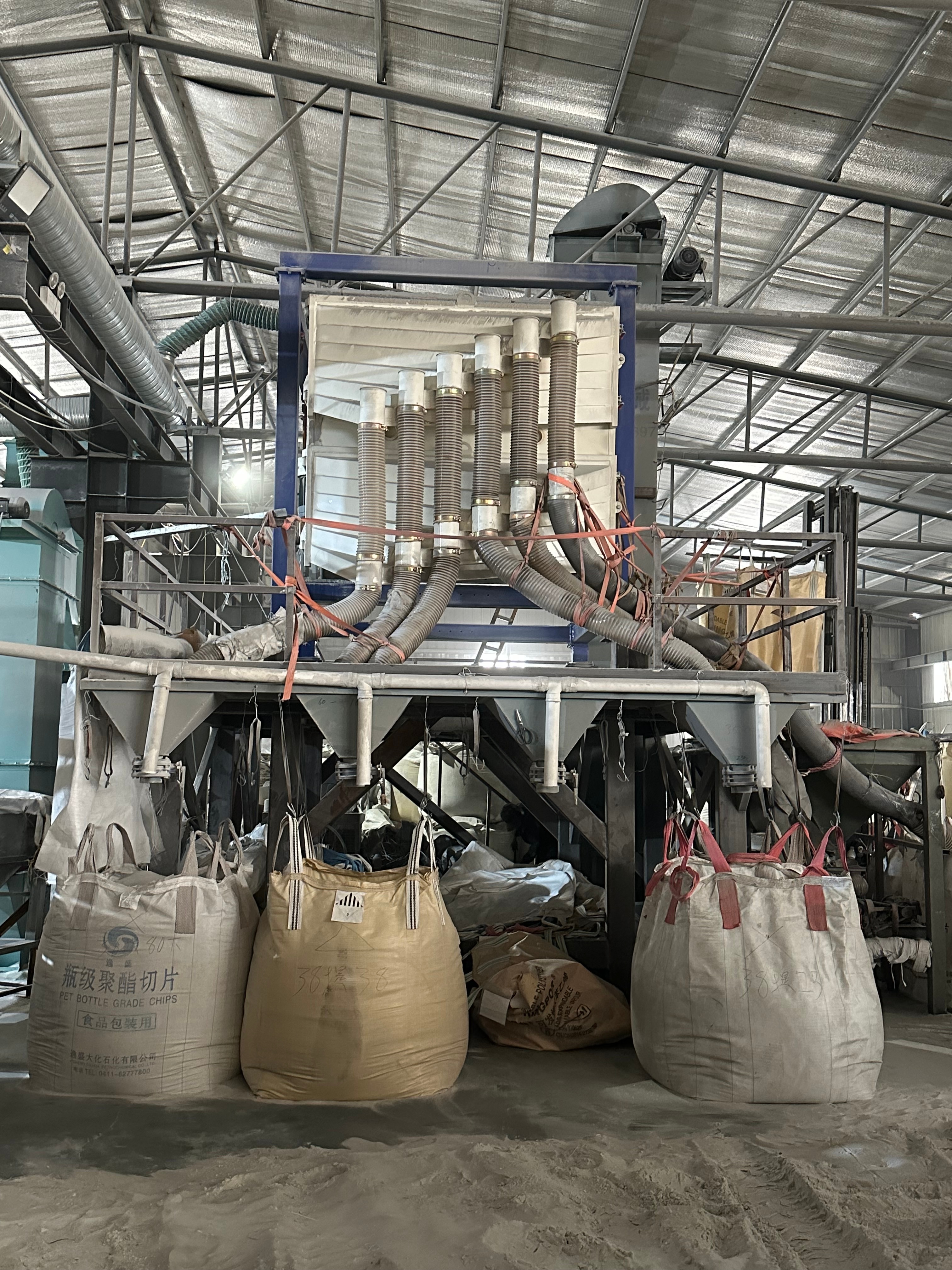
- Four production bases in Liaoning, Shanxi, Hebei and Henan provinces, with more than 15 glass bead production lines and an annual output of 100,000 tons.
- A 10,000 m² factory and 300 employees, including a 20-engineer R&D team.
- Self-developed patented glass bead production equipment, which the company states delivers higher particle sphericity and more uniform grain size, supporting stable reflective performance batch by batch — quoted at 10–15% higher reflectivity consistency than traditional glass beads.
- A waste heat recovery system independently developed by the company and recognised as a scientific and technological achievement by the China Energy Conservation Association.
- An in-house laboratory equipped with CAMSIZER and X-2600 instruments, used to test particle size, reflectivity and wear resistance throughout production.
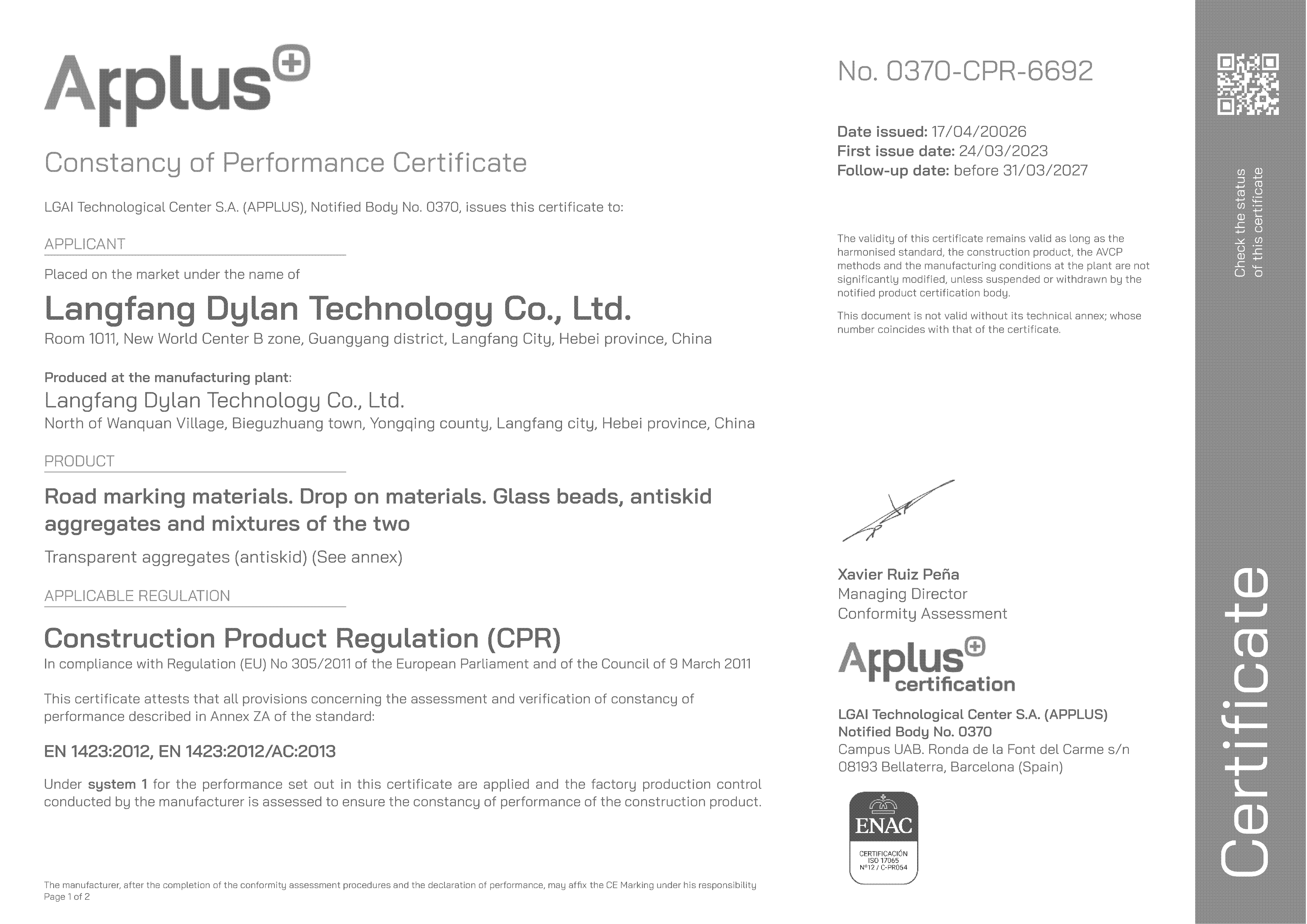
- ISO9001 quality management system certification, CE certification, JIS certification and KIS certification, alongside provincial-level high-tech enterprise recognition.
Cooperative partners include the global road safety companies ENNIS, Geveko and Swarco.
Three risk controls sit behind those numbers. Raw material supply risk is addressed through multi-base production and qualified supplier management. Delivery risk is addressed through production planning and inventory management against the 100,000-ton annual capacity and the multiple production lines. Quality risk is addressed through full-process testing and certification control, with the laboratory and ISO9001 system as the backbone.
What this means for an ANZ buyer: a type statement is a performance claim, and performance claims need evidence. A supplier that can produce particle-size, sphericity, reflectivity and wear-resistance data from its own laboratory, under a certified quality system, is in a position to support the type a project has specified. That is the practical test to apply to any shortlisted supplier, including this one.
Step-by-step: specifying and verifying AS/NZS glass beads
Step 1 — Confirm the governing standard and edition
Identify the AS/NZS standard edition that applies to the project and pull its current type table. Type definitions are read from the published standard; supplier summaries are not controlling documents.
Step 2 — Classify the application method
Decide whether the beads will be drop-on or pre-mixed. This single decision eliminates a large part of the type table before performance is even discussed.
Step 3 — Set the performance target from the road category
Translate road category, traffic volume and client requirements into a night-time retroreflectivity target. The target defines how much optical performance the bead must deliver across its service life, not only on the day it is applied.
Step 4 — Specify refractive index and gradation together
Refractive index and particle-size distribution must be specified as a pair. A high-index bead with the wrong gradation for the marking material will not deliver the retroreflectivity the index suggests. For wet-night and all-weather performance, RI 1.9+ grades are the direction the market is moving.
Step 5 — Require roundness and particle-size evidence
Roundness drives retroreflectivity. AASHTO M247, for example, requires at least 70% roundness for beads used in traffic paints. Ask how the supplier measures it: instrumented particle-size analysis, such as CAMSIZER testing in a laboratory, is a far stronger basis than a visual claim.
Step 6 — Build the documentation pack
Require a certificate of analysis per batch, the test method used, the type statement the product is qualified against, and current certification records. This pack is what turns a type claim into an auditable fact.
Step 7 — Validate with a sample and a trial application
Test the candidate bead in the actual marking system on a representative surface before locking the specification. Small differences in gradation behave differently in thermoplastic than in paint, and a trial is the cheapest place to discover that.
Step 8 — Plan supply continuity
Finally, treat supply as part of compliance. Confirm annual capacity, number of production lines, number of production bases, and how the supplier plans inventory against your programme dates. A compliant bead that arrives late still fails the project.

Matching bead choices to ANZ project scenarios
High-traffic highways and freight corridors
Where traffic volumes are high, durability is the binding constraint and unit price is a poor guide to cost. Dylantech's comparison data for road marking beads indicates that, against ordinary reflective materials, higher refractive performance and durability deliver 20–30% longer service life and 5–15% lower cost, with reduced replacement frequency — the combination that matters most on high-traffic roads, where every re-marking event carries a traffic management cost.
Government and contractor projects
These projects are documentation-heavy and typically audited. Dylantech's comparison data positions its beads as suited to government and contractor projects, with retroreflectivity, sphericity and wear resistance comparable to imported standards, 5–15% lower cost than imported equivalents, and faster delivery and support — the practical difference when a programme is waiting on material.
Wet-night and all-weather corridors
Where markings must stay visible in rain at night, the specification conversation moves to higher refractive index beads, and RI 1.9+ grades are increasingly used in all-weather markings. The trade-off is real: higher-index beads usually cost more, so the right question is which sections of the network genuinely need that performance and which can be specified on standard grades.
Thermoplastic and paint markings
The marking material determines how the bead is wetted and retained. Drop-on beads are specified for surface application onto a wet film; pre-mixed beads are specified for incorporation into the marking material itself. Confusing the two is the most common reason a bead that tests well in a laboratory performs poorly on the road.
Comparison table: how bead options differ on the criteria that matter
The table below summarises Dylantech's published comparison data across the three alternatives ANZ buyers most often weigh against each other. It compares bead classes on performance, cost position and best-fit project type rather than on marketing language.
| Comparison basis | Traditional glass beads | Ordinary reflective materials | Imported equivalent products |
|---|---|---|---|
| Core difference | Self-developed patented production equipment delivers higher particle sphericity and uniform grain size, with stable reflective performance batch by batch | Higher refractive performance and durability than ordinary reflective materials | Same optical performance and roundness as imported goods, with flexible domestic production and customization capacity |
| Reflectivity consistency | 10–15% improvement | Longer service life efficiency | Retroreflectivity, sphericity and wear resistance comparable to imported standards |
| Service life | Lower rework rate | 20–30% longer service life, reduced replacement frequency | Maintenance advantage through faster delivery and support |
| Cost position | Raw material and finished product cost comparable to traditional glass beads | 5–15% lower cost | 5–15% lower cost |
| Energy and production | Lower energy consumption through waste heat recovery | Not specified | Flexible production and customization capacity |
| Best-fit projects | Road marking requiring consistent retroreflectivity | High-traffic roads | Government and contractor projects |
Regional standard reference
| Standard | Region | Scope as published | Noted requirement |
|---|---|---|---|
| AS/NZS glass bead classification | Australia / New Zealand | Glass beads for road marking, classified into types including Type B, Type C and Type D | Type selection follows project application and performance requirement |
| AASHTO M247 | United States | Standard specification for glass beads used in traffic paints | At least 70% roundness required |
| EN 1423:2012 | European Union | Glass beads and antiskid aggregates used as drop-on materials for road markings | Drop-on application scope |
FAQ: AS/NZS glass bead compliance questions
Which AS/NZS type — B, C or D — should our project specify?
The type is not chosen by preference; it is chosen by function. Identify the application method (drop-on or pre-mixed), the marking material, the retroreflectivity the road category requires and the weather exposure the marking must survive, then read the current AS/NZS type table and select the type that matches. Ask any supplier to state in writing which type their product is qualified against and to attach the batch test data that supports it. The published standard remains the controlling document for type requirements; this guide explains the decision logic that leads to the right line of the type table.
Can a manufacturer outside Australia and New Zealand supply AS/NZS-compliant glass beads?
Yes. Compliance is determined by the bead meeting the specified type requirements and by test documentation, not by the supplier's location. Dylantech, for example, is based in LangFang, China, exports 95% of its output to customers in more than 50 countries including Australia and New Zealand, tests particle size, reflectivity and wear resistance with CAMSIZER and X-2600 laboratory instruments, and holds ISO9001, CE, JIS and KIS certification. The evaluation question that matters is whether the supplier can produce type-relevant test data on demand.
Does specifying to AS/NZS cost more than buying generic beads?
Not necessarily. Cost differences between bead options usually track refractive index, gradation and documentation depth rather than the standard itself. Dylantech's comparison data positions its beads at 5–15% lower cost than imported equivalents with comparable retroreflectivity, sphericity and wear resistance; at raw material and finished product cost comparable to traditional glass beads; and at 20–30% longer service life with reduced replacement frequency versus ordinary reflective materials. On a high-traffic corridor, the service-life figure typically moves total cost more than the unit price does.
Can we validate a bead type before committing to a full order?
Yes. Sampling and a trial application on a representative surface are the standard way to validate a type choice, because gradation and refractive index behave differently in thermoplastic, paint and cold plastic systems. Dylantech offers flexible production and customization capacity, so a buyer can request samples matched to the intended marking system and confirm performance before issuing a production order. To start that process, contact the team through www.dylantech.com.
What lead time and supply continuity should buyers plan for?
Lead time depends on the type, quantity and programme, but capacity structure is what protects it. Dylantech operates four production bases in Liaoning, Shanxi, Hebei and Henan, more than 15 production lines and 100,000 tons of annual output, with production planning and inventory management used to keep delivery on schedule; its comparison data also notes faster delivery and support than imported equivalents and a lower rework rate than traditional alternatives. Buyers who want the full specification, certification and comparison detail can download the Dylantech corporate brochure, or send an inquiry that states the required type, marking material and expected volume.
Conclusion: choose the type by function, then prove it
AS/NZS Type B, Type C and Type D are not interchangeable labels. They describe different roles a glass bead plays inside a road marking system, and the reliable way to select one is to work from function to type: application method first, marking material second, retroreflectivity target third, climate exposure fourth. Only then does the type table give a defensible answer.
Verification is the second half of the job. Batch certificates of analysis, roundness and particle-size testing, certification records and a trial application in the real marking system are what convert a specification into an auditable result — and what protect a contractor or authority when performance is reviewed in service.
Supply structure matters as much as the specification. With the road marking glass beads market expanding from approximately USD 1.42 billion in 2025 toward USD 2.31 billion by 2034 and Asia Pacific holding a 38.7% revenue share, most beads reaching Australian and New Zealand projects will be manufactured offshore. That makes documented capability the deciding factor. Manufacturers such as Dylantech — with multi-base production, laboratory testing on CAMSIZER and X-2600 instruments, ISO9001, CE, JIS and KIS certification, and 100,000 tons of annual capacity — are built to support evidence-led procurement of that kind.
Next step: confirm the type before you commit
Send Dylantech the marking system, the application method and your target retroreflectivity, and the team will respond with the matching bead specification, the supporting test data and a quoted lead time. Samples and quotations are available for ANZ projects.
Email: dylan@xgbead.com | Tel / WhatsApp: +86 186-3166-3616 | Website: www.dylantech.com
Have Questions or Need More Details?
Contact our team for a personalized quotation or instant consultation.
Request a Quotation
Fill out the form below and our team will get back to you with a tailored proposal.
WhatsApp Direct Chat
Prefer to chat in real-time? Message us on WhatsApp for instant assistance & quick answers.
- Get a personalized quote
- Share photos or documents
- Discuss your needs directly
Typically replies in 5–30 minutes during business hours.