
EN 1423 vs EN 1424: Choosing the Right Glass Beads for Your Road Marking Project

Short answer: EN 1423 and EN 1424 are not two quality tiers of the same bead. EN 1423 is the European standard whose published scope covers glass beads, anti-skid aggregates and mixtures applied as drop-on materials on road markings. EN 1424 is the reference cited for premix glass beads, meaning beads blended into the marking material before it is applied. The deciding question is therefore not which standard is stronger, but how the beads enter your marking system. A single project can require both.
Most procurement problems in road marking are not brand problems. They are specification-role problems: the purchase order names one standard while the application method belongs to the other. Because both European references regularly appear in the same tender pack, buyers naturally read them as alternatives. They are not. They describe two different jobs that glass beads perform inside the same marking system.
This guide is written for specifiers, contractors, importers and distribution partners who already know they need reflective glass beads and now have to justify, in writing, which standard their project requires. It draws on the published scope of EN 1423, an official specification mapping that assigns drop-on and premix beads to EN 1423 and EN 1424 respectively, and the Dylantech catalogue, in which Glass Beads EN1423 and Glass Beads EN1424 are both produced from recycled glass as part of the road safety product line.
The Problem: A Head-to-Head Question With a Role-Based Answer
Head-to-head comparisons usually assume a winner. For EN 1423 versus EN 1424, that assumption is the problem.
When a buyer asks a supplier for EN 1424 beads or EN 1423 beads without describing where the beads will be applied, the quotation may be perfectly valid for one application and unusable for another. The bead can sit inside the correct overall size range of 0.5 mm to 20 mm and still be specified for the wrong role in the marking system.
Three failure patterns appear repeatedly in this decision:
- Premix beads ordered for a drop-on application. The specification assumed beads would be broadcast onto the marking, but the order is built around beads intended to be blended into the marking material.
- Drop-on beads ordered for a premix system. The beads are introduced into the binder instead of being placed onto the surface, so the intended surface function is not delivered as planned.
- Only one standard ordered when the project needs two. A marking that contains premixed beads and also receives a drop-on top dressing needs both product lines. Discovering that at the paving stage forces a second order, and with a documented production lead time of 45 to 60 days that is a schedule risk, not just a purchasing inconvenience.
Industry Background: Why Two European Standards Sit Side by Side
EN 1423 is defined by its scope, not by a performance ranking. The published description of the standard states that it specifies the requirements applicable to glass beads, anti-skid aggregates, and the mixture of the two, which are applied as drop-on materials on road marking products.
The clearest practical mapping between the two standards comes from official specification guidance. The Highways Department of the Hong Kong SAR Government, in its Guidance Notes on Road Markings, references BS EN 1423 for drop-on glass beads and BS EN 1424 for premixed glass beads. The sample specification in the appendix goes further: drop-on glass beads shall comply with BS EN 1423, premixed glass beads shall comply with BS EN 1424, and the refractive index of the glass beads shall conform to at least Class A (n greater than or equal to 1.5).
That single document demonstrates the operating logic: one specification, two standards, because the marking system uses beads in two places. The versus framing is a procurement convenience rather than a technical contest.
Other jurisdictions express the same idea through different documents. In the United States, AASHTO M 247-26, effective from 1 July 2026, defines glass bead types from Type 0, a uniform gradation, through Type 5, including modified gradations. Texas requires road marking glass beads to conform to DMS-8290, which specifies three bead gradations tested using Tex-831-B. In China, GB/T 24722-2020, effective from 1 July 2021, is the current national standard for glass beads used in road markings. A supplier serving several markets therefore has to hold several gradation families at once, which is why product catalogues are normally organised by standard and model rather than around a single bead.
Market data points in the same direction. The global glass beads for road marking market was valued at USD 1.18 billion in 2025 in a commercial market research assessment, and beads with a refractive index of 1.5 accounted for 54.0% of that value, the leading category because it aligns with conventional road-marking specifications. Higher-index variants exist as a specified requirement rather than a default: Potters Industries, for example, lists standard 1.5 and high-reflective 1.9 refractive index beads in its traffic safety range.

EN 1423 vs EN 1424: Head-to-Head Comparison
The table below compares the two standards on the dimensions that actually influence a purchase decision: application role, catalogue model, gradation, material and the evidence a buyer can verify.
| Comparison dimension | EN 1423 | EN 1424 |
|---|---|---|
| Role in the marking system | Drop-on material: beads applied onto the marking | Premix material: beads blended into the marking before application |
| Published scope or official reference | Scope covers glass beads, anti-skid aggregates and mixtures applied as drop-on materials on road markings | Cited in official road marking guidance as the reference for premixed glass beads |
| Dylantech catalogue model | Glass Beads EN1423 (model EN1423) | Glass Beads EN1424 (model EN1424) |
| Catalogued particle size scope | 850-180 micrometres and 710-125 micrometres | 1400-355 micrometres |
| Overall size range | 0.5 mm - 20 mm | 0.5 mm - 20 mm |
| Primary material | Recycled glass | Recycled glass |
| Industry application | Road marking / road safety | Road marking / road safety |
| Colour and size options | Custom colour and size available | Custom colour and size available |
| Supplier quality evidence | ISO 9001 certificate 23226Q00027R001 (CFC), GB/T 19001-2016/ISO 9001:2015, EU and US markets | Same certificate and management system covering glass bead exports |
The gradation difference is worth noting for planning purposes. The catalogued EN1424 scope of 1400-355 micrometres is coarser than the two EN1423 scopes of 850-180 micrometres and 710-125 micrometres. That difference reflects the two roles: beads blended into a marking material before application are handled differently from beads placed onto a finished surface.
Detailed Solution: How Dylantech Covers Both Standards
LangFang Dylan Technology Co., Ltd. (Dylantech) is a glass bead manufacturer founded in 2004, operating four production bases in Liaoning, Shanxi, Hebei and Henan provinces with more than 15 glass bead production lines and a stated annual output of 100,000 tons. The company reports a 10,000 square metre facility, approximately 300 employees and a 20-engineer R&D team, with a 95% export ratio and main markets in the EU, USA, South East Asia and the Middle East.
For a buyer resolving the EN 1423 versus EN 1424 question, the relevant point is that both standards are represented as separate catalogue models rather than one product being repositioned for both roles:
- Glass Beads EN1423 (model EN1423) - catalogued in scopes of 850-180 micrometres and 710-125 micrometres, made from recycled glass, for road marking and road safety.
- Glass Beads EN1424 (model EN1424) - catalogued in a scope of 1400-355 micrometres, made from recycled glass, for road marking and road safety.
- Both models are listed with a 0.5 mm to 20 mm size range and with custom colour and size available.
The surrounding portfolio matters when a project, a distributor or a tender requires more than one standard in a single shipment. Dylantech also catalogues BS6088A (1180-425 micrometres) and BS6088B (850-180 micrometres), AASHTO M247 Type 1 (1180-150 micrometres) through Type 4 (2000-850 micrometres), AS/NZS Type B (850-75 micrometres), Type C (1300-425 micrometres) and Type D (1700-710 micrometres), OPSS1750 (850-150 micrometres), GB05 (800-80 micrometres), plus higher refractive index models RI 1.6 (1000-180 micrometres) and RI 1.7 (1180-180 micrometres).

Verifiable quality and production evidence
Specification decisions are only as good as the supplier evidence behind them. The documented quality position includes:
- ISO 9001 certification, certificate number 23226Q00027R001, issued by CFC against the GB/T 19001-2016/ISO 9001:2015 standard, covering exports of glass products (glass beads) to EU and US markets, issued 27 June 2026 and valid to 26 June 2029.
- Additional certification stated in the company profile: CE, JIS and KIS.
- An in-house laboratory equipped with CAMSIZER and X-2600 instruments for detecting particle size, reflectivity and wear resistance, with 100% testing applied through production.
- Production capacity of 10,000 tons per month, a minimum order quantity of 1 ton, a lead time of 45 to 60 days, OEM production with documented customisation options, and remote after-sales support.
Project records for road marking engineering companies and traffic safety manufacturers include deliveries of 1, 20, 56, 72, 108 and 198 tons, all applied to increase the reflective refractive index of road marking performance. Reported outcomes include stability over three years, four years in one record, with low wear noted, and one trial record highlighting a strong night-time effect.

Step-by-Step: Deciding Which Standard Governs Your Project
- Map how the beads enter the marking. Drop-on, premix, or both. This single answer resolves most of the ambiguity before any supplier is contacted.
- Assign the reference standard to that role. Drop-on beads map to EN 1423. Premix beads map to EN 1424, following the mapping used in official road marking guidance.
- Confirm gradation against the project's own test regime. A European project works from the gradation requirements of the named standard; a US state project may instead reference DMS-8290 with three gradations tested under Tex-831-B, or AASHTO M 247-26 Types 0 to 5.
- Set the refractive index class explicitly. The Hong Kong sample specification requires at least Class A (n greater than or equal to 1.5), and 1.5 RI beads represent 54.0% of global market value, the conventional specification class. Treat a higher index as a specified requirement rather than an assumed upgrade.
- Verify supplier evidence, not supplier adjectives. Check the certificate number, issuing body, standard version, validity dates, scope and covered markets, and check which instruments perform batch testing and whether testing is 100%.
- Close the commercial variables. Minimum order quantity, lead time, packing, custom colour or size, OEM requirements, and a trial lot where the project schedule allows.
Use Cases: Where Each Standard Carries the Decision
1. Markings that use premixed beads plus a drop-on top dressing
This is the case that produces the EN 1423 or EN 1424 question in its most misleading form, because the answer is both. The premixed portion of the glass bead content follows EN 1424, and the surface-applied portion follows EN 1423. A supplier able to produce both from recycled glass, in the required scopes, removes the need for a second vendor approval.
2. Markings where beads are applied to the fresh surface only
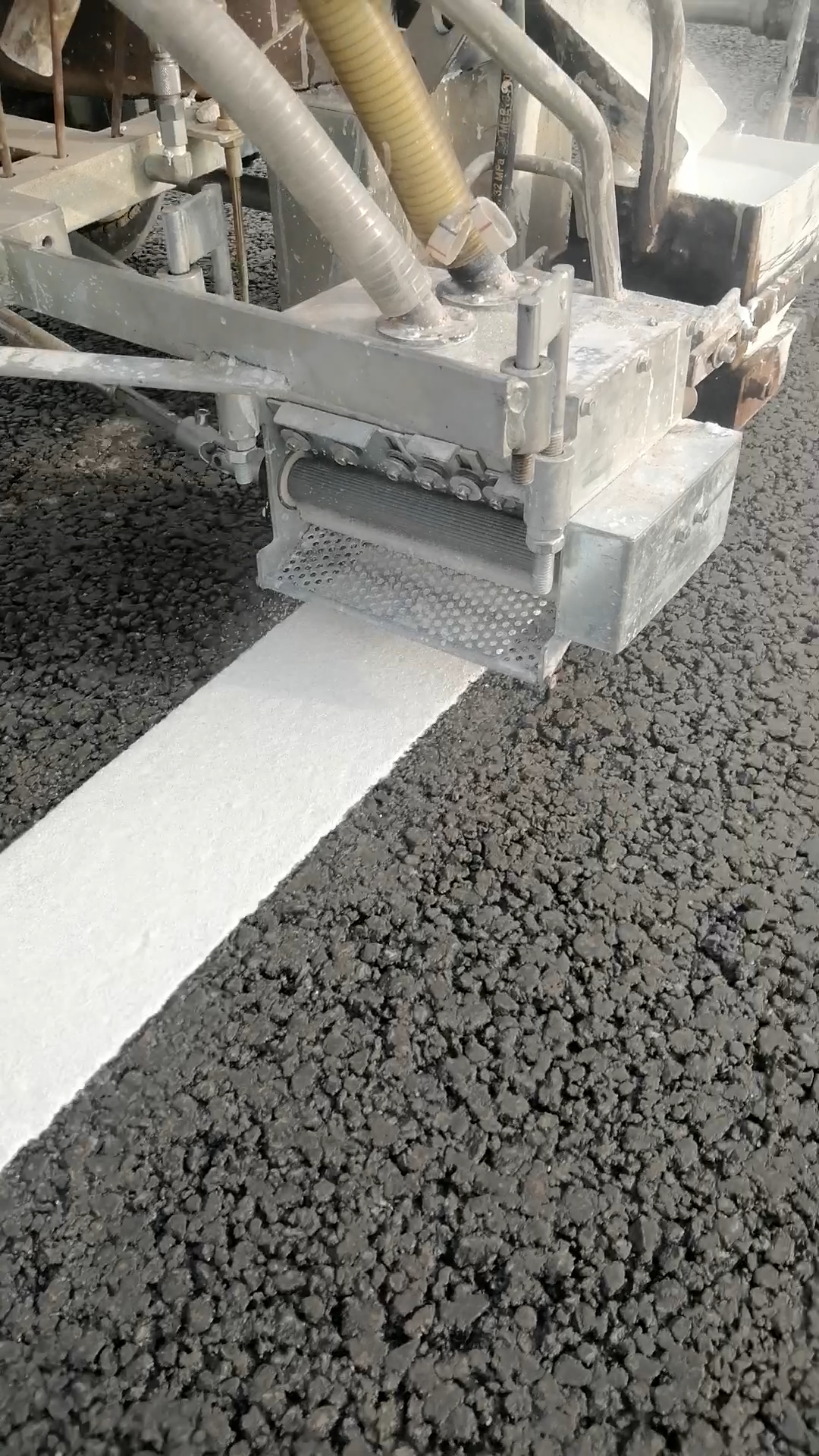
Where the marking material is applied first and beads are then broadcast onto it, the bead is functioning as a drop-on material, the role EN 1423 addresses. In this configuration the EN 1423 scopes of 850-180 micrometres or 710-125 micrometres are the relevant catalogue references.
3. Multi-market distribution portfolios
A distributor serving European, North American and Asia-Pacific projects cannot plan around a single standard. Holding EN 1423 and EN 1424 grades alongside BS6088, AASHTO M247 and AS/NZS types allows one container to serve several specifications, and a 1-ton minimum order makes it practical to test a new grade without committing to a full project quantity.
4. Projects with a specified higher refractive index
Where a specification sets a higher refractive index than the conventional class, the catalogue RI 1.6 (1000-180 micrometres) and RI 1.7 (1180-180 micrometres) models sit alongside the EN 1423 and EN 1424 grades, so the same supplier relationship can cover both the standard and the higher-index line items.
Cost, Capacity and Lead Time: What the Numbers Allow You to Plan
Dylantech does not publish unit prices, and no pricing figure is asserted here. What can be planned from documented capability is the order structure: a 1-ton minimum order quantity, 10,000 tons of monthly capacity, and a 45 to 60 day lead time. In practice, cost differences between EN 1423 and EN 1424 beads come from gradation yield, refractive index, surface treatment, packing and whether the order covers one grade or two, which is why the role mapping in step one should be settled before price comparison begins.
FAQ: EN 1423 vs EN 1424 in Real Procurement
If my specification names only one standard, which applies, EN 1423 or EN 1424?
The role decides. Official road marking guidance references BS EN 1423 for drop-on glass beads and BS EN 1424 for premixed glass beads, and the associated sample specification requires each type to comply with its respective reference. If your beads are applied onto the marking, EN 1423 governs. If they are blended into the marking material before application, EN 1424 governs.
Can one supplier deliver both EN 1423 and EN 1424 glass beads in the gradations I need?
Where the catalogue covers both, yes. Dylantech lists Glass Beads EN1423 in 850-180 micrometres and 710-125 micrometres scopes and Glass Beads EN1424 in a 1400-355 micrometres scope, both made from recycled glass for road marking and road safety. The same portfolio includes BS6088A and BS6088B, AASHTO M247 Type 1 to Type 4, AS/NZS Type B, C and D, OPSS1750, GB05 and RI 1.6 / RI 1.7 grades, produced across four bases with more than 15 lines and a stated annual output of 100,000 tons.
What drives the price difference between EN 1423 and EN 1424 beads, and what is the minimum order?
No list price is published. The commercial variables are gradation yield, refractive index, surface treatment, packing and whether one grade or two are ordered. The minimum order quantity is 1 ton and monthly capacity is 10,000 tons, so both single-grade and combined orders can be scheduled within the 45 to 60 day lead time.
Can I validate both grades before committing to a full project order?
Yes. A 1-ton minimum order supports trial quantities, and documented project records include a 1-ton trial for a road marking engineering company alongside deliveries of 20, 56, 72, 108 and 198 tons. Reported results include three-year stability with low wear, and one trial record notes a strong night-time effect.
What lead time should I plan for when I need both standards?
Documented lead time is 45 to 60 days, so a combined EN 1423 and EN 1424 requirement should be raised as a single purchase order and scheduled against the project calendar rather than split across separate orders. To start, send your specification and gradation requirement through dylantech.com or WhatsApp +86 186-3166-3616, and request a sample lot or quotation for the exact grades your project names.
Conclusion: The Standard Follows the Application
EN 1423 and EN 1424 do not compete. One addresses glass beads applied as drop-on materials onto road markings, and the other is the reference for premix glass beads blended into the marking. The question of which is more critical resolves into a single answer: the standard that is critical is the one that matches how your beads enter the marking, and where a system uses both, both standards are critical at the same time.
For a supplier to be useful in that decision, it needs both grades in its catalogue, verifiable certification behind them, and the capacity to produce a combined order. Dylantech catalogues Glass Beads EN1423 and Glass Beads EN1424 from recycled glass within a wider standards-based range, backed by ISO 9001 certification covering EU and US exports, in-house particle size, reflectivity and wear-resistance testing, and a stated 100,000-ton annual output.
Next step: match your marking system to the right standard
Send us the application method (drop-on, premix or both) and the gradation your specification names. We will confirm which grade applies and prepare a sample or quotation.
Email: dylan@xgbead.com · WhatsApp / Tel: +86 186-3166-3616 · Web: www.dylantech.com
Download the company brochure: Corporate Brochure (PDF)

Have Questions or Need More Details?
Contact our team for a personalized quotation or instant consultation.
Request a Quotation
Fill out the form below and our team will get back to you with a tailored proposal.
WhatsApp Direct Chat
Prefer to chat in real-time? Message us on WhatsApp for instant assistance & quick answers.
- Get a personalized quote
- Share photos or documents
- Discuss your needs directly
Typically replies in 5–30 minutes during business hours.