
Top 10 Glass Bead Types for Road Marking: A Ranking of Reflective and Industrial Grades
Top 10 Glass Bead Types for Road Marking: A Ranking of Reflective and Industrial Grades
Ten glass bead types cover the majority of road-marking and industrial specifications in use today: the AASHTO M247 Type 1 to Type 4 family, EN 1423, EN 1424, BS 6088A and BS 6088B, the AS/NZS Type B/C/D family, high-refractive-index grades such as RI 1.6 and RI 1.7, and the GB05 grinding grade. This page ranks them by how broadly they are specified, explains what each one is selected for, and shows how Dylantech gradations map onto each designation.

A buyer opening a road-marking specification for the first time usually meets the same wall of codes: M247, EN 1423, BS 6088, AS/NZS Type B. Each code names a gradation, not a brand, and the difference between two of them can be as small as 30 micrometres at the bottom of the sieve band. That small difference decides whether a bead works as a drop-on reflective element in thermoplastic, as a premix component, or as a blasting and polishing media in a completely different industry.
How this ranking was built: the order reflects how widely each designation appears in road-marking procurement and how easily a buyer can source it as a defined, repeatable gradation. It is an editorial ranking based on the standard designations and sieve ranges Dylantech produces and supplies. It is not a sales-volume ranking, and it does not rank suppliers.
What Counts as a Distinct Glass Bead Type
A glass bead type is defined by three things that travel together in a purchase order: the governing standard, the sieve gradation, and the optical or functional role the bead performs. Two beads can share the same base material and still be different types, because a 1180–150 μm drop-on bead and an 800–80 μm grinding bead are not interchangeable in either application.
In road marking, the functional distinction is straightforward. A reflective glass bead is embedded in or dropped onto a marking and returns light from vehicle headlights back toward the driver. In industrial use, the bead is a working media: it polishes, it blasts, it grinds, or it decorates a surface. A single production base can make both families, but the gradation control, the surface finish and the tolerance band are specified differently.
Dylantech glass beads are supplied with a size range of 0.5 mm to 20 mm, in transparent, opaque or mixed colour, with a smooth or matte surface finish. Custom colour and custom size are available on request. That range is what makes a ten-item ranking possible from one supplier rather than ten.
Practical rule: when a specification names a standard, treat the standard as mandatory and the gradation as negotiable only inside the tolerance band the standard allows. When a specification names only "reflective glass beads", the gradation is the first thing to pin down.
Why the Gradation List Keeps Growing
Glass beads are a globally traded commodity with an unusually concentrated supply base. China alone accounted for approximately 57.4% of total global glass bead exports in 2024, with an export value of roughly USD 928 million and the UAE and India among the top destinations, according to OEC data compiled from UN Comtrade records. For a buyer, that concentration is the reason standardisation matters: most projects source across borders, so the specification has to be readable in more than one market.
The road-marking segment of that trade is growing on its own curve. Dataintelo values the global road marking glass beads market at approximately USD 1.42 billion in 2025, with a projected reach of USD 2.31 billion by 2034. Asia Pacific held a 38.7% revenue share in 2025, driven largely by highway expansion programmes — which is also why the AS/NZS and Asian regional gradations appear more often in international enquiries than their market size alone would suggest.
On the supply side, the sector has recognised leaders. Potters Industries LLC, Swarco AG and 3M Company are identified as the top three global players in the glass beads for road marking sector in Dataintelo and Mordor Intelligence reporting. Dylantech is a specialist producer rather than a multi-line chemical group: LangFang Dylan Technology Co., Ltd. was established in 2004, operates a 10,000 m² manufacturing facility with approximately 300 staff and four production bases in Liaoning, Shanxi, Hebei and Henan provinces, and runs an annual production capacity of 100,000 tons with a 20-engineer R&D team. Export accounts for 95% of sales, with the EU, USA, Southeast Asia and the Middle East as the major markets.
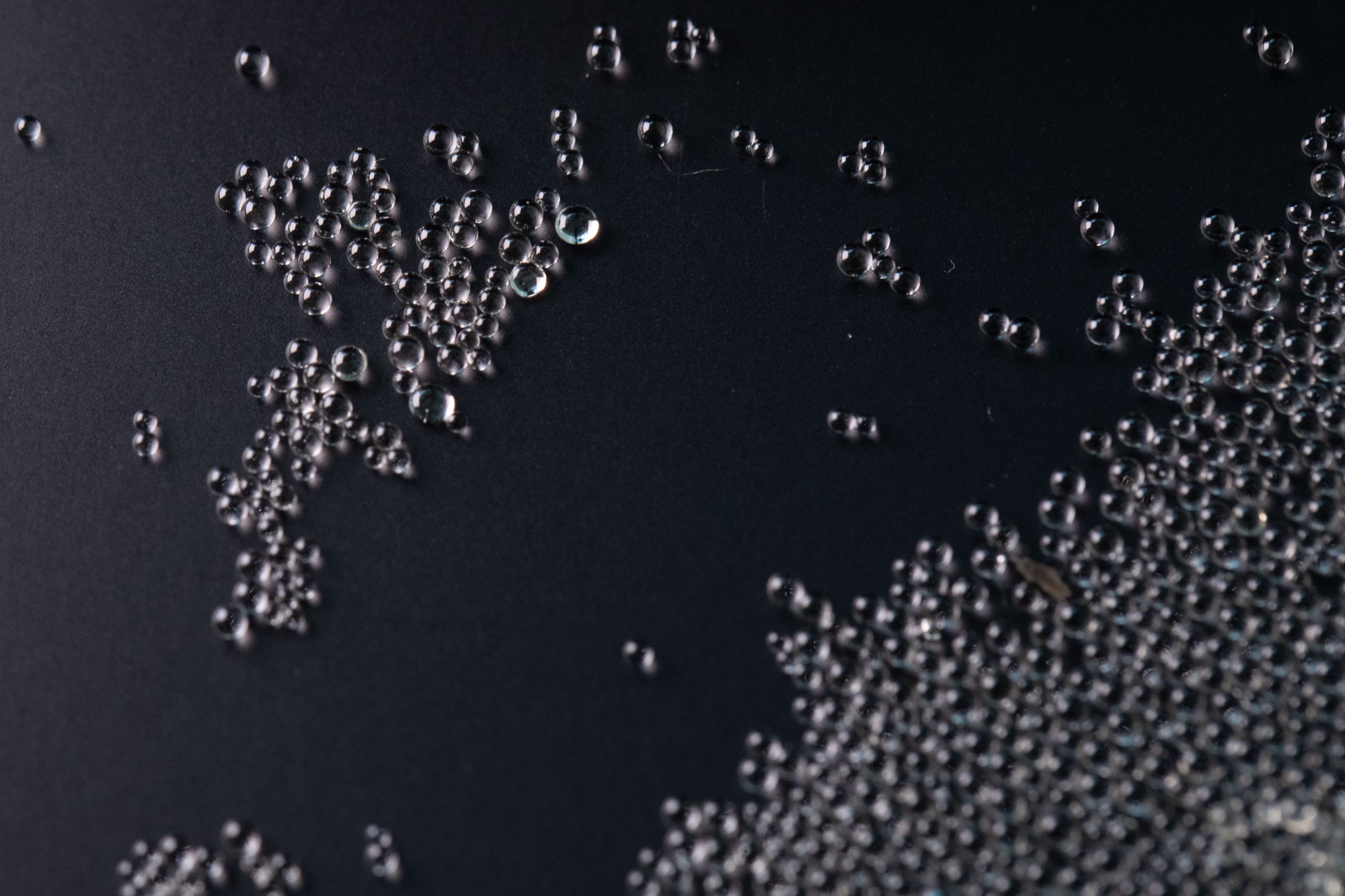
The Top 10 Glass Bead Types, Ranked
The ranking below runs from the gradation most frequently written into public road specifications to the more specialised industrial grades. Where a standard defines a family of gradations rather than a single bead, the family is grouped into one rank so that the list stays usable.
1. AASHTO M247 Type 1 (1180–150 μm)
This is the baseline reflective bead in United States traffic paint specifications and, in practice, the most commonly quoted single gradation in the road-marking market. AASHTO M247 is the standard specification for glass beads used in traffic paints in the United States, and it classifies beads into types while requiring at least 70% roundness. Dylantech produces a Type 1 designated bead from recycled glass with a sieve range of 1180 to 150 micrometres, in transparent, opaque or mixed colour, with smooth or matte finish and custom options.
Selection rationale: choose Type 1 when the marking system is a standard highway or urban paint line and the project specifies US practice. The tight lower cut at 150 μm keeps the fine fraction low, which matters where the marking is expected to hold retroreflectivity rather than release fines.
2. AASHTO M247 Type 2 (1180–180 μm)
Type 2 shares the 1180 μm top size with Type 1 but opens the lower band to 180 μm, so the distribution carries more mid-size particles. Dylantech supplies it from recycled glass in the same colour and finish options.
Selection rationale: this is the grade to specify when the project accepts a broader distribution. Because the two gradations share a top size, a buyer can compare them directly on the same drop-on equipment without re-qualifying the application method — the difference sits entirely in the retained fraction.
3. AASHTO M247 Type 3 and Type 4 (1700–710 μm / 2000–850 μm)
The coarse end of the M247 family. Type 3 is graded 1700–710 μm and Type 4 is graded 2000–850 μm, both produced by Dylantech from recycled glass. These are large-drop beads, generally associated with high-build and profiled marking systems rather than standard flat paint lines.
Selection rationale: coarse beads are selected when the marking geometry itself does more of the reflective work. Because the beads sit higher in the film, the gradation has to be matched to the film build rather than to the paint chemistry alone. If a project engineer is designing a profiled or high-build line, Type 3 and Type 4 are the two M247 options to evaluate.
4. EN 1423 (850–180 μm and 710–125 μm)
EN 1423:2012 is the European harmonised standard for glass beads and antiskid aggregates used as drop-on materials for road markings, published by CEN. Dylantech produces two scopes under this designation: 850–180 μm and 710–125 μm.
Selection rationale: EN 1423 is the reference point for European drop-on specifications and for any market that has adopted EN practice. The two scopes exist for the same reason Type 1 and Type 2 exist in the US family — one narrower band, one wider. Buyers comparing a European and a US specification should note that the grading bands are not numerically identical, even where the functional role overlaps.
5. EN 1424 (1400–355 μm)
The coarser European designation produced by Dylantech, graded 1400–355 μm from recycled glass.
Selection rationale: this gradation belongs in the enquiry whenever a European project specifies both a drop-on and a premix component, because the two are graded separately and cannot be substituted for each other. Its position in this ranking reflects the fact that it is specified less often than EN 1423, not that it is less important in the projects that use it.
6. BS 6088A (1180–425 μm)
The coarser of the two BS 6088 designations, produced by Dylantech from recycled glass in transparent, opaque or mixed colour, with smooth or matte finish and custom colour and size available.
Selection rationale: BS 6088A is the wider-banded UK grade, suited to specifications that tolerate a broader particle distribution in exchange for coverage. Buyers working to British practice normally treat 6088A and 6088B as a pair rather than as alternatives.
7. BS 6088B (850–180 μm)
The finer BS 6088 gradation, 850–180 μm, intended for road marking and road safety applications and manufactured from recycled glass.
Selection rationale: choose 6088B where the specification calls for a tighter, finer drop-on distribution. Because 6088B shares its grading band with the 850–180 μm EN 1423 scope, it is the grade most often used to bridge a UK specification and a European one in the same tender package.
8. AS/NZS Type B, Type C and Type D (850–75 μm / 1300–425 μm / 1700–710 μm)
Dylantech produces three AS/NZS designations from recycled glass: Type B at 850–75 μm, Type C at 1300–425 μm and Type D at 1700–710 μm.
Selection rationale: the three gradations are a graded family, so the selection question is which band the project specifies rather than which bead is "better". Type B is the fine band; Type C and Type D move progressively coarser. Buyers in Australia, New Zealand and neighbouring markets should confirm the band in the project specification before quoting, because the same family name is sometimes used loosely in tenders.
9. High refractive index grades: RI 1.6 (1000–180 μm) and RI 1.7 (1180–180 μm)
These are the optical-performance grades in the ranking. Refractive index governs how much light a bead returns to the driver, and the market has moved toward higher-index beads for wet-night conditions: high refractive index glass beads in the RI 1.9+ range are increasingly used in all-weather markings to improve visibility during wet night driving, according to Swarco and Mordor Intelligence reporting. Dylantech manufactures 1.6 and 1.7 index grades for road marking and road safety, at 1000–180 μm and 1180–180 μm respectively.
Selection rationale: specify a high-index grade where the project brief mentions wet-night visibility, high-speed roads or a retroreflectivity target that a standard-index bead will not reach. The important procurement point is that RI must be stated explicitly, because a standard bead and a high-index bead can share a similar gradation and still behave very differently on the road.
10. Industrial and functional grades: GB05, sandblasting and decorative beads
The last rank belongs to the grades that leave the pavement entirely — or serve a decorative rather than a safety function.
- GB05 grinding glass beads — recycled glass, 800–80 μm, intended for road marking and road safety supply chains as well as grinding and finishing use.
- Sandblasting glass beads — produced across the 0.5 mm to 20 mm range from recycled glass, used for polishing and blast cleaning, operating in batch feeding mode with coating or blasting machines.
- Decorative glass beads — recycled glass, 0.5 mm to 20 mm, transparent, opaque or mixed colour, smooth or matte finish, used in decorative applications including swimming pools and surface finishing.
Selection rationale: these grades are ranked last only because they are specified outside road construction. Their inclusion matters for buyers who purchase more than one product family: a distributor or importer can consolidate reflective, blasting, grinding and decorative grades into a single sourcing relationship rather than managing four suppliers.
Additional gradations produced but not ranked above
Dylantech also produces further gradations under the glass beads category. They are listed here for completeness rather than ranked, because their specification frequency in public tenders sits below the top ten.
| Model designation | Sieve / particle scope | Material |
|---|---|---|
| TYPE IA | 850–75 μm | Recycled glass |
| TYPE IB | 300–63 μm | Recycled glass |
| TYPE IIA | 1000–180 μm | Recycled glass |
| TYPE IIB | 600–75 μm | Recycled glass |
| TYPE IIC | 1000–300 μm | Recycled glass |
| OPSS1750 | 850–150 μm | Recycled glass |
| GRINDING | 600–1000 μm / 800–1200 μm | Glass |
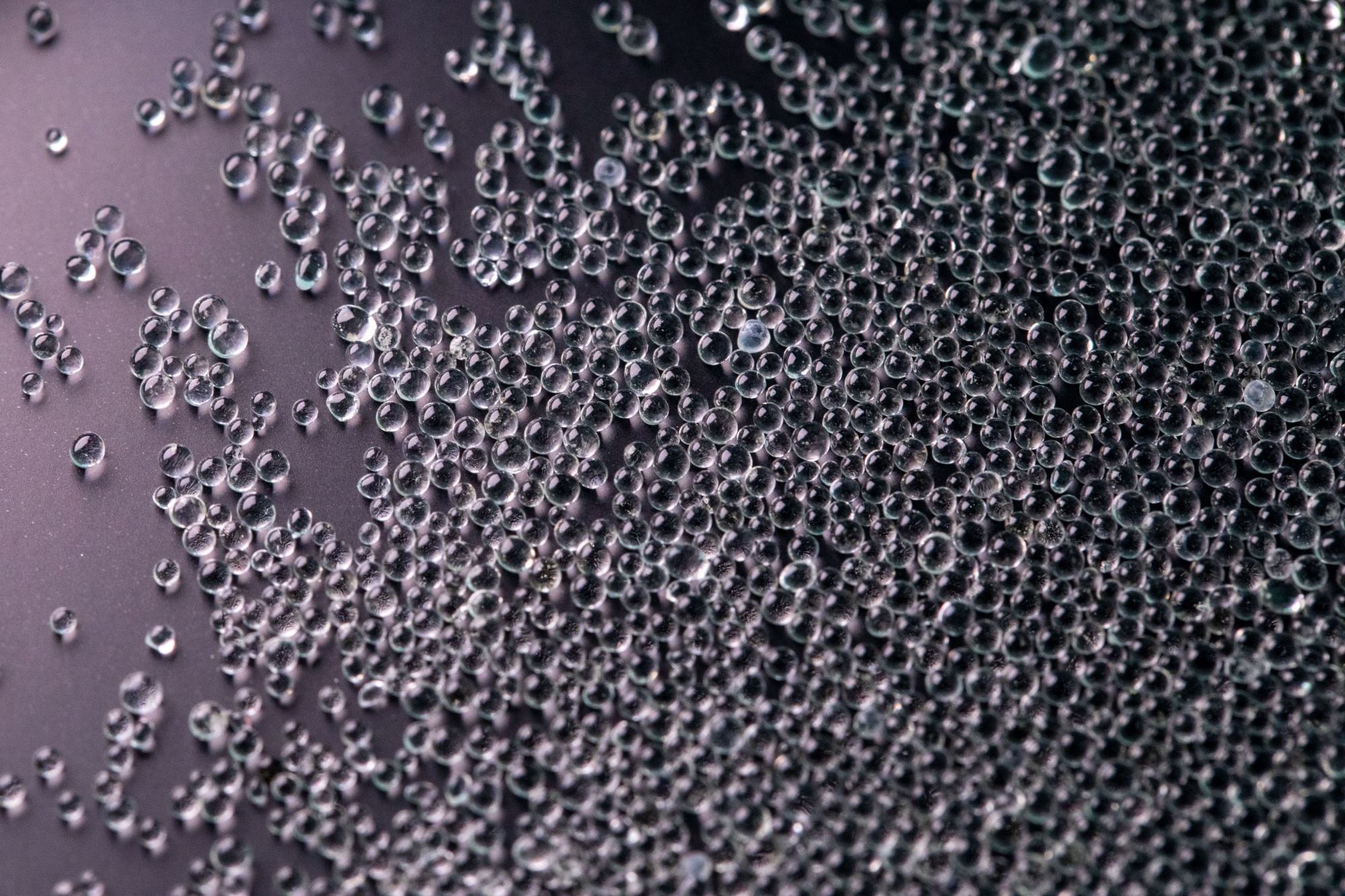
How to Work Through This Ranking: Step-by-Step
Ranking a bead type is only useful if it produces a decision. Working through the following five steps in order prevents the most common procurement error, which is selecting a gradation that satisfies the standard but not the application.
- Establish the governing standard for the destination market. AASHTO M247 for US practice, EN 1423 and EN 1424 for European drop-on and premix specifications, BS 6088A or 6088B for British practice, AS/NZS Type B, C or D for Australia and New Zealand. Confirm this before any technical discussion, because the standard determines the permitted gradation bands.
- Fix the gradation inside that standard. Choose the band that matches the marking system and the film build. A 1180–150 μm bead and a 1700–710 μm bead both satisfy their own specifications and are still not interchangeable on the same line.
- Decide whether the project needs a stated refractive index. If the brief mentions wet-night visibility or a reflectivity target, the enquiry must name RI explicitly. Dylantech grades are available at RI 1.6 and RI 1.7 alongside standard reflective beads.
- Confirm material, colour and finish requirements. Dylantech supplies beads made from recycled glass and beads made from glass, across transparent, opaque and mixed colour options, with smooth or matte surface finish. If the specification calls for a specific colour or finish, state it in the enquiry rather than in a follow-up message.
- Validate with a physical sample before committing to volume. Gradation and roundness are measurable properties. A sample check against the stated sieve band is the cheapest point in the whole process to catch a mismatch.
Where Each Grade Fits: Use Cases
Highway and interurban lines. The standard reflecting grades carry this work: AASHTO M247 Type 1 and Type 2 in US-facing projects, BS 6088B and EN 1423 in Europe and the UK, AS/NZS Type B in Australia and New Zealand. Where a wet-night performance clause exists, the high-index RI 1.6 and RI 1.7 grades enter the specification.
Profiled, high-build and coarse-drop markings. This is the territory of the coarse bands — AASHTO M247 Type 3 and Type 4, EN 1424, BS 6088A, AS/NZS Type C and Type D. The selection driver is film build and profile geometry rather than traffic volume.
Wet-night and all-weather visibility. The shift toward higher-refractive-index beads in all-weather markings is one of the clearest product trends in the sector. Buyers should read this as a specification change, not a marketing change: it means the RI value has to be written into the tender documents.
Industrial surface treatment. Sandblasting glass beads and GB05 grinding beads operate in batch feeding mode with coating or blasting machines, used for polishing and surface preparation. These products share the same 0.5 mm to 20 mm overall size range as the road-marking grades but are specified on completely different criteria.
Decorative and architectural applications. Decorative glass beads, available in transparent, opaque and mixed colour with smooth or matte finish, serve decorative use including swimming pool finishes. Dylantech states that custom colour and custom size are available for this range.

Comparison Table: The Top 10 at a Glance
| Rank | Designation | Dylantech gradation | Material | Generally specified for |
|---|---|---|---|---|
| 1 | AASHTO M247 Type 1 | 1180–150 μm | Recycled glass | Standard US drop-on reflective beads |
| 2 | AASHTO M247 Type 2 | 1180–180 μm | Recycled glass | US drop-on where a wider band is permitted |
| 3 | AASHTO M247 Type 3 / Type 4 | 1700–710 μm / 2000–850 μm | Recycled glass | Coarse, high-build and profiled markings |
| 4 | EN 1423 | 850–180 μm; 710–125 μm | Recycled glass | European drop-on materials for road markings |
| 5 | EN 1424 | 1400–355 μm | Recycled glass | Coarser European designated gradation |
| 6 | BS 6088A | 1180–425 μm | Recycled glass | Wider-banded UK road marking grade |
| 7 | BS 6088B | 850–180 μm | Recycled glass | Finer UK road marking grade |
| 8 | AS/NZS Type B / C / D | 850–75 μm / 1300–425 μm / 1700–710 μm | Recycled glass | Australia and New Zealand road marking |
| 9 | RI 1.6 / RI 1.7 | 1000–180 μm / 1180–180 μm | Glass | Higher-index optical performance, wet-night visibility |
| 10 | GB05 / Sandblasting / Decorative | 800–80 μm; all sizes; all sizes | Recycled glass | Grinding, blast cleaning and polishing, decorative use |
Two columns are deliberately absent: price and lead time. Neither is a property of the bead type, both are commercial variables that depend on gradation, quantity and delivery destination, and neither should be inferred from a public ranking.
Frequently Asked Questions
Which standard should I specify — AASHTO M247, EN 1423/1424, BS 6088 or AS/NZS?
The destination market decides. AASHTO M247 is the standard specification for glass beads used in traffic paints in the United States, and it requires at least 70% roundness. EN 1423:2012 is the European harmonised standard for glass beads and antiskid aggregates used as drop-on materials for road markings, with EN 1424 as the coarser European designation. BS 6088A and BS 6088B cover British practice, and AS/NZS Type B, C and D cover Australia and New Zealand. Dylantech produces gradations against all four families, so the standard is confirmed first and the gradation is selected inside it.
Can one supplier cover both road-marking and industrial grades?
Dylantech produces both from the same manufacturing system. The road-marking side covers AASHTO M247 Type 1 to Type 4, EN 1423, EN 1424, BS 6088A, BS 6088B, AS/NZS Type B/C/D, the TYPE IA to TYPE IIC gradations, OPSS1750, RI 1.6 and RI 1.7. The industrial side covers GB05 grinding beads, sandblasting glass beads, grinding glass beads at 600–1000 μm and 800–1200 μm, and decorative glass beads. All are supplied in a 0.5 mm to 20 mm size range with transparent, opaque or mixed colour and smooth or matte finish, and custom colour and size are available on request. LangFang Dylan Technology Co., Ltd. was established in 2004, operates four production bases in Liaoning, Shanxi, Hebei and Henan provinces, and has an annual production capacity of 100,000 tons.
What drives the cost difference between glass bead grades?
Cost follows the specification, not the brand. A quotation is built around four variables: the sieve gradation, whether a refractive index is specified, the colour and surface finish, and the quantity. Two gradations inside the same standard family can sit at different points on a quotation, which is why buyers comparing AASHTO M247 Type 1 and Type 2, or EN 1423 and EN 1424, get the clearest picture by putting both gradations into a single enquiry rather than pricing them separately.
Can I get a sample of a specific gradation before ordering?
Yes. Gradation and roundness are measurable, and checking a physical sample against the stated sieve band is the cheapest point in the process to catch a mismatch. Dylantech handles sample and specification requests directly through dylan@xgbead.com or WhatsApp on +86 186-3166-3616, and a single sample request can cover several gradations, because reflective, blasting, grinding and decorative beads are all produced from the same 0.5 mm to 20 mm range.
How is lead time and large-volume supply handled?
Dylantech does not quote one standard lead time across all grades, because the schedule depends on the gradation, the quantity and the destination. What can be confirmed up front is capacity: four production bases across Liaoning, Shanxi, Hebei and Henan provinces, more than 15 professional production lines, an annual output of 100,000 tons and a 20-engineer R&D team. Export accounts for 95% of sales, with the EU, USA, Southeast Asia and the Middle East as the major markets, and cooperative partners have included ENNIS, Geveko and Swarco. For volume planning, send the gradation list and the required quantity, and the production schedule can be confirmed against real capacity rather than an estimate.
Conclusion
The ten types ranked here are not alternatives competing for the same job. They are a ladder running from AASHTO M247 Type 1 at the standard US drop-on end, through the European, British and AS/NZS families, to the high-index optical grades and finally to the industrial and decorative products that never see a road surface. The selection work is done by the standard and the gradation, in that order.
What buyers should take away is narrower and more useful than a list: name the standard, fix the sieve band inside it, state the refractive index if the project mentions wet-night performance, confirm material, colour and finish, and check a sample before committing to volume. A supplier who can hold all ten gradations to a measurable tolerance removes an entire layer of risk from that process.
Next step
If you are comparing gradations for a specific project, send the standard and the intended application. Dylantech can confirm the matching gradation, the available colour and finish options, and sample arrangements, and will quote against the real specification rather than a generic grade.
Email dylan@xgbead.com · WhatsApp +86 186-3166-3616 · www.dylantech.com
Download the full product range and company profile: Corporate Brochure (PDF)

Have Questions or Need More Details?
Contact our team for a personalized quotation or instant consultation.
Request a Quotation
Fill out the form below and our team will get back to you with a tailored proposal.
WhatsApp Direct Chat
Prefer to chat in real-time? Message us on WhatsApp for instant assistance & quick answers.
- Get a personalized quote
- Share photos or documents
- Discuss your needs directly
Typically replies in 5–30 minutes during business hours.