
Glass Beads Compliance by Region: EN 1423/1424, AASHTO M247, AS/NZS & BS 6088
Glass Beads Compliance by Region: EN 1423/1424, AASHTO M247, AS/NZS & BS 6088

A reflective glass bead passes inspection only when it matches the standard named in the project specification — and those specifications are regional. EN 1423, AASHTO M247, AS/NZS and BS 6088 each define their own particle-size envelopes and their own acceptance expectations, so two containers both labelled "reflective glass beads" can behave completely differently on the same road.
This guide maps each regional designation to the gradations actually supplied by Dylantech — LangFang Dylan Technology Co., Ltd., a glass bead manufacturer based in LangFang, China, producing road safety raw materials for customers in more than 50 countries and regions. The mapping covers the type-designated range TYPE IA, IB, IIA, IIB and IIC, plus the EN1423, EN1424, AASHTO M247 Type 1–4, AS/NZS Type B/C/D, BS6088A and BS6088B models, and closes with the purchasing terms and acceptance criteria a buyer should confirm before ordering.
Problem Definition: Why the Same Bead Fails a Different Regional Specification
The direct answer is that regional glass bead standards are not interchangeable, and the difference that causes rejections at site testing is usually gradation — the particle-size envelope — not colour, packaging or price.
AASHTO M247 is the standard specification for glass beads used in traffic paints in the United States. It classifies beads into types and requires at least 70% roundness. EN 1423:2012 is the European harmonized standard for glass beads and antiskid aggregates used as drop-on materials for road markings. A tender that references AS/NZS Type C, or BS 6088A in the United Kingdom, is pointing at a different envelope again.
Three failure patterns repeat in cross-border purchasing:
- Gradation drift. A supplier ships a generic "standard" drop-on bead whose envelope sits outside the type named in the specification. The material can look correct and still fail the receiving test.
- Naming confusion. Type numbers from one system do not transfer to another. A bead held as a fine grade in one market may not satisfy a project that names a coarse Type 4 or a Type D envelope.
- Undocumented material claims. Recycled-glass content, roundness and refractive index are declared in the offer but not evidenced in the test documentation that arrives with the batch.
For a buyer, the practical consequence is that the specification, the model code and the inspection clause must be aligned before the purchase order is issued, not after the material reaches the site.
Industry Background: A Cross-Border Supply Chain Built on Regional Rules
Road marking glass beads are a global trade rather than a regional one. China accounted for approximately 57.4% of total global glass bead exports in 2024, with an export value of roughly USD 928 million, according to OEC data compiled from UN Comtrade. Demand-side estimates point the same way: Dataintelo values the global road marking glass beads market at approximately USD 1.42 billion in 2025, projected to reach USD 2.31 billion by 2034, with Asia Pacific holding a 38.7% revenue share in 2025.
The structural consequence is easy to see. A bead is typically produced in one region and installed under the rules of another, and the two regions rarely use identical type names or identical envelopes. Suppliers who work across the EU, USA, Southeast Asia and the Middle East carry the whole range rather than a single national grade — a pattern reflected in Dylantech's four production bases in Liaoning, Shanxi, Hebei and Henan, more than 15 professional glass bead production lines, and an annual output of 100,000 tons, with partners that include ENNIS, Geveko and Swarco.
Detailed Solution: Regional Standard → Product Model → Gradation
Every model in the mapping below shares the same base specification: a size range of 0.5 mm to 20 mm, transparent, opaque or mixed colour, smooth or matte surface finish, and custom colour and size available. The differentiator is the gradation envelope and the standard designation it answers to.
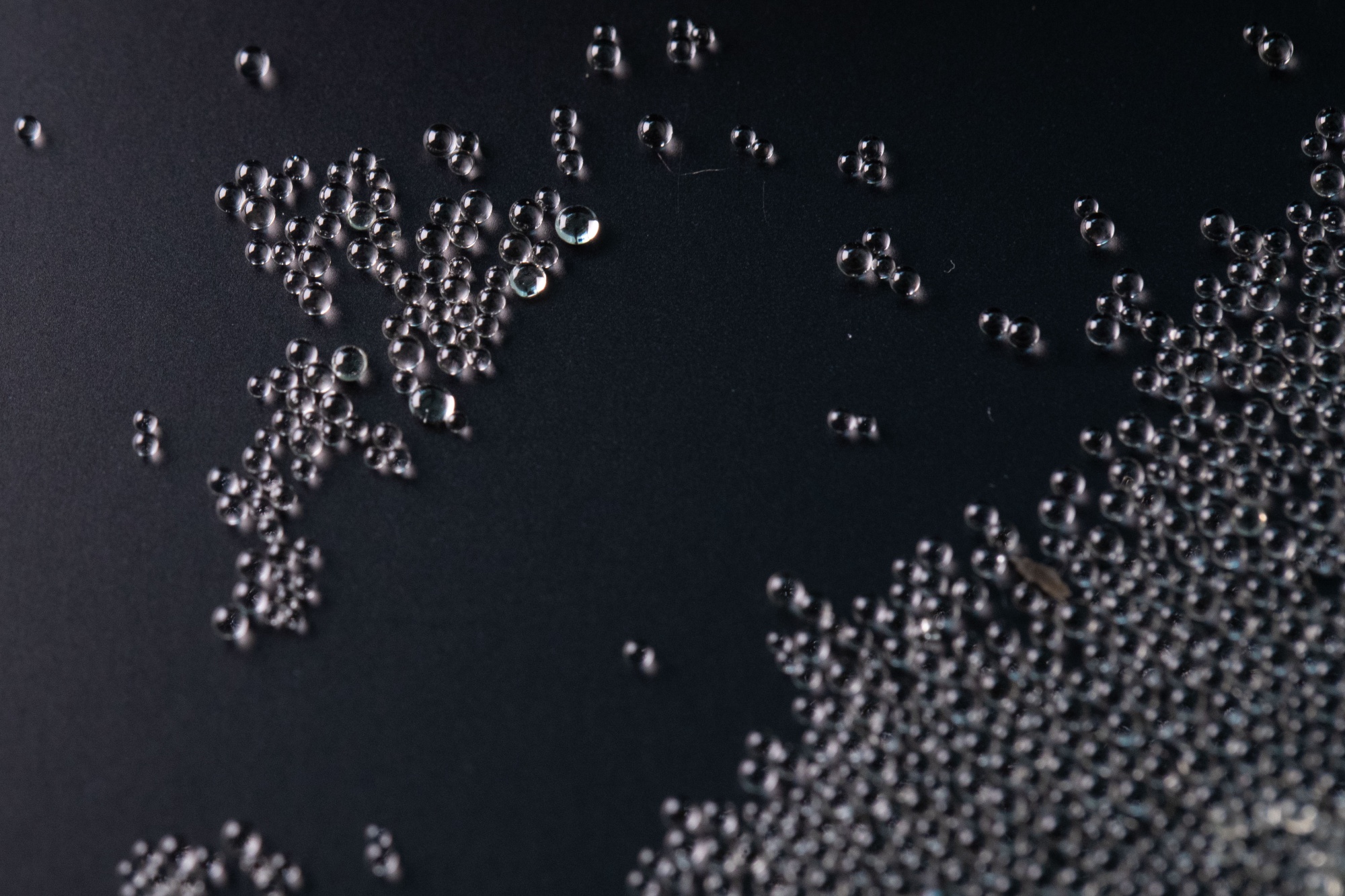
Europe: EN 1423 and EN 1424
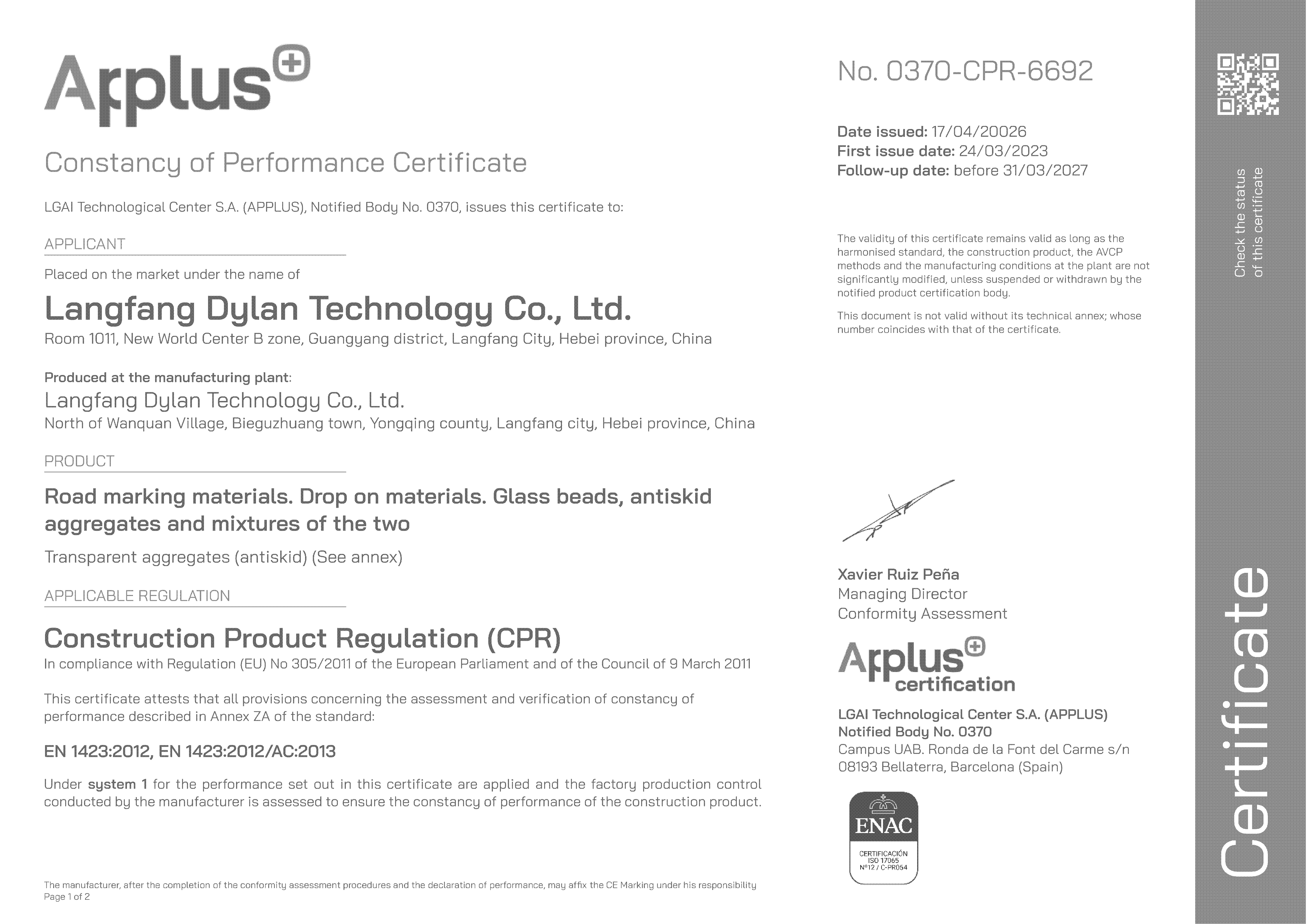
EN 1423:2012 is the European harmonized standard for glass beads and antiskid aggregates used as drop-on materials for road markings. Dylantech supplies two gradations under the EN1423 designation and one under EN1424, all produced from recycled glass:
- GLASS BEADS EN1423 — 850–180 μm, recycled glass
- GLASS BEADS EN1423 — 710–125 μm, recycled glass
- GLASS BEADS EN1424 — 1400–355 μm, recycled glass
These are distinct catalogue designations with different envelopes and are not interchangeable on a purchase order, so the buyer should confirm which designation the road authority applies to the specific marking system before the enquiry is released.
United States: AASHTO M247 Types 1–4
AASHTO M247 is the standard specification for glass beads used in traffic paints in the United States. It classifies beads into types and requires at least 70% roundness. Dylantech produces the four type designations at the following gradations, all from recycled glass:
- GLASS BEADS AASHTO M247-TYPE 1 — 1180–150 μm
- GLASS BEADS AASHTO M247-TYPE 2 — 1180–180 μm
- GLASS BEADS AASHTO M247-TYPE 3 — 1700–710 μm
- GLASS BEADS AASHTO M247-TYPE 4 — 2000–850 μm
The roundness requirement is the acceptance point that most often separates a compliant bead from a borderline one. It belongs in the inspection clause next to the gradation, not in a general quality statement.
Australia and New Zealand: AS/NZS Type B, C and D
- AS/NZS TYPE B — 850–75 μm, recycled glass
- AS/NZS TYPE C — 1300–425 μm, recycled glass
- AS/NZS TYPE D — 1700–710 μm, recycled glass
Type B is the fine end of this group; Type D is the coarse end. Buyers working to an AS/NZS reference should treat the type letter as the controlling instruction and the micron range as its technical translation.
United Kingdom: BS 6088A and BS 6088B
- GLASS BEADS BS6088A — 1180–425 μm, recycled glass
- GLASS BEADS BS6088B — 850–180 μm, recycled glass
Type-Designated Range: TYPE IA, IB, IIA, IIB and IIC
These five models are the general type-designated beads used across road marking and road safety specifications, all supplied from recycled glass:
- GLASS BEADS TYPE IA — 850–75 μm
- GLASS BEADS TYPE IB — 300–63 μm
- GLASS BEADS TYPE IIA — 1000–180 μm
- GLASS BEADS TYPE IIB — 600–75 μm
- GLASS BEADS TYPE IIC — 1000–300 μm
TYPE IB is the finest envelope in this range at 300–63 μm, which makes it the model to check first when a marking system calls for a fine grade. TYPE IA and AS/NZS Type B share the same 850–75 μm envelope, and TYPE IIA and TYPE IIC cover the mid-range band between roughly 1000 and 180 μm on the coarse side.
Additional gradations in the road marking catalogue
- GLASS BEADS OPSS1750 — 850–150 μm, recycled glass
- GLASS BEADS GB05 — 800–80 μm, recycled glass
- GLASS BEADS RI 1.6 — 1000–180 μm
- GLASS BEADS RI 1.7 — 1180–180 μm
RI 1.6 and RI 1.7 are produced from glass rather than recycled glass and are listed for road marking and road safety use. Industry attention is also moving toward higher-index beads for all-weather markings, where visibility in wet night conditions is the design objective. Buyers specifying that performance should confirm the refractive index requirement against the standard in their own region and against the marking system, rather than assuming any index grade will do.
Cross-Region Gradation Overlaps: Where One Model Answers Two Standards
Because regional standards define envelopes rather than unique products, several Dylantech gradations sit inside two designations at once. This matters to distributors and project suppliers who must hold stock for more than one market:
| Gradation envelope | Models sharing the same envelope | Region / designation |
|---|---|---|
| 850–75 μm | GLASS BEADS TYPE IA · AS/NZS TYPE B | Type-designated · Australia / New Zealand |
| 1700–710 μm | GLASS BEADS AASHTO M247-TYPE 3 · AS/NZS TYPE D | United States · Australia / New Zealand |
| 850–180 μm | GLASS BEADS EN1423 · GLASS BEADS BS6088B | Europe · United Kingdom |
| 1180–180 μm | GLASS BEADS AASHTO M247-TYPE 2 · GLASS BEADS RI 1.7 | United States · Type-designated index grade |
| 1000–180 μm | GLASS BEADS TYPE IIA · GLASS BEADS RI 1.6 | Type-designated range |
Sharing an envelope does not make two products identical. Material source and refractive index still differ — TYPE IIA is recycled glass while RI 1.6 is glass — and a specification that names roundness, index or recycled content will separate them again. What the overlap does mean is that the particle-size requirement itself does not have to be duplicated for every market a supplier serves.

Step-by-Step Breakdown: From Tender Clause to Accepted Delivery
Compliance is a sequence, not a single check. Each step below produces a document or a decision that the next step depends on.
- Identify the governing standard and type. Read the specification for the regional designation — EN 1423 or EN 1424, AASHTO M247 Type 1–4, AS/NZS Type B/C/D, BS 6088A or 6088B, or a type-designated grade such as TYPE IIA. Record it exactly as written; do not translate it yourself at this stage.
- Convert the designation into a micron envelope. The type letter or number is the instruction; the envelope is what the laboratory measures. Use the mapping tables in this guide to establish the numeric range.
- Match the envelope to a catalogue model. Confirm the model code and gradation in writing, including any tolerance the supplier applies.
- Confirm material and performance requirements. Road paving applications typically require high roundness, a stable refractive index and eco-friendly recycled material. These attributes should be stated as requirements, not as descriptive adjectives.
- Confirm the application method and matched equipment. The relevant road paving application uses batch feeding with a coating or blasting machine, and the matched equipment set includes road marking machines, sand blasting machines and polishing equipment. Working conditions are outdoor all-weather at normal temperature and pressure, so the bead specification must hold across that range.
- Agree commercial terms. Dylantech's standard capability position is a minimum order quantity of 1 ton, monthly capacity of 10,000 tons, a lead time of 45–60 days, OEM customisation on voltage and logo, 100% testing, export coverage to the EU, and remote after-sales support.
- Fix the acceptance criteria and evidence. Agree what the receiving test will measure and which document proves it. Dylantech operates a laboratory with CAMSIZER and X-2600 instruments for particle size, reflectivity and wear resistance checks, and holds ISO9001, CE, JIS and KIS certifications. Certificates and batch test data should be listed in the contract.
- Validate with a sample before the full order. Run the agreed gradation through the actual application equipment, then release the volume order.
Use Cases: How the Mapping Works on Real Projects
European drop-on specification. A road marking contractor working to EN 1423 selects GLASS BEADS EN1423 at 850–180 μm where a standard drop-on envelope is required, and the 710–125 μm EN1423 grade where a finer envelope is specified. The project requirement set is high roundness, stable refractive index and eco-friendly recycled material, with batch feeding through a coating or blasting machine.
United States traffic paint programme. The specification cites AASHTO M247 Type 2, which corresponds to a 1180–180 μm envelope. The 70% roundness requirement of the standard is written into the inspection clause alongside the gradation, so the supplier and the testing laboratory are measuring the same thing.
Australia and New Zealand road marking. AS/NZS Type C at 1300–425 μm for a coarse drop-on application, or AS/NZS Type B at 850–75 μm where a finer envelope is named. Where the same supplier serves both markets, AS/NZS Type D and AASHTO M247 Type 3 can be held as one 1700–710 μm stock line, capped with the correct documentation for each destination.
Volume supply to road marking contractors and traffic safety manufacturers. Production orders placed with Dylantech for the purpose of increasing the reflective refractive index of road performance have ranged from 1 ton and 20 tons through 56, 72 and 108 tons to 198 tons. Reported outcomes across three to four years of use are stability, low wear and a clearly visible night effect.
Comparison Table: Regional Designations at a Glance
The table below lists the verified catalogue models by region, designation, gradation and material. Application for every road marking row is road marking and road safety.
| Region / standard | Catalogue model | Gradation | Material | Application |
|---|---|---|---|---|
| Europe — EN 1423 | GLASS BEADS EN1423 | 850–180 μm | Recycled glass | Road marking / road safety |
| Europe — EN 1423 | GLASS BEADS EN1423 | 710–125 μm | Recycled glass | Road marking / road safety |
| Europe — EN 1424 | GLASS BEADS EN1424 | 1400–355 μm | Recycled glass | Road marking / road safety |
| USA — AASHTO M247 Type 1 | GLASS BEADS AASHTO M247-TYPE 1 | 1180–150 μm | Recycled glass | Road marking / road safety |
| USA — AASHTO M247 Type 2 | GLASS BEADS AASHTO M247-TYPE 2 | 1180–180 μm | Recycled glass | Road marking / road safety |
| USA — AASHTO M247 Type 3 | GLASS BEADS AASHTO M247-TYPE 3 | 1700–710 μm | Recycled glass | Road marking / road safety |
| USA — AASHTO M247 Type 4 | GLASS BEADS AASHTO M247-TYPE 4 | 2000–850 μm | Recycled glass | Road marking / road safety |
| Australia / New Zealand — AS/NZS Type B | AS/NZS TYPE B | 850–75 μm | Recycled glass | Road marking / road safety |
| Australia / New Zealand — AS/NZS Type C | AS/NZS TYPE C | 1300–425 μm | Recycled glass | Road marking / road safety |
| Australia / New Zealand — AS/NZS Type D | AS/NZS TYPE D | 1700–710 μm | Recycled glass | Road marking / road safety |
| United Kingdom — BS 6088A | GLASS BEADS BS6088A | 1180–425 μm | Recycled glass | Road marking / road safety |
| United Kingdom — BS 6088B | GLASS BEADS BS6088B | 850–180 μm | Recycled glass | Road marking / road safety |
| Type-designated range | TYPE IA / IB / IIA / IIB / IIC | 850–75 · 300–63 · 1000–180 · 600–75 · 1000–300 μm | Recycled glass | Road marking / road safety |
| Additional gradations | GLASS BEADS OPSS1750 · GB05 | 850–150 μm · 800–80 μm | Recycled glass | Road marking / road safety |
| Index grades | GLASS BEADS RI 1.6 · RI 1.7 | 1000–180 μm · 1180–180 μm | Glass | Road marking / road safety |
FAQ: Regional Glass Bead Compliance
Which standard applies to my project — EN 1423, AASHTO M247, AS/NZS or BS 6088?
The standard that applies is the one named in the project specification or the road authority's requirement for that market. AASHTO M247 is the US specification for glass beads used in traffic paints and classifies beads into types with a minimum 70% roundness requirement. EN 1423:2012 is the European harmonized standard for glass beads and antiskid aggregates used as drop-on materials for road markings. AS/NZS Type B, C and D and BS 6088A and B are the designations used in Australia/New Zealand and the United Kingdom respectively. Because the envelopes differ, the safest approach is to quote the designation exactly as written in the tender and ask the supplier to confirm the matching gradation in microns.
Can one supplier deliver beads that match different regional gradations?
Yes, provided the supplier manufactures the full envelope range rather than a single national grade. Dylantech's road marking range covers the EN1423 grades at 850–180 μm and 710–125 μm, EN1424 at 1400–355 μm, AASHTO M247 Types 1 to 4 from 1180–150 μm to 2000–850 μm, AS/NZS Type B/C/D, BS6088A and BS6088B, and the type-designated TYPE IA, IB, IIA, IIB and IIC models. All road marking models are produced from recycled glass except the RI 1.6 and RI 1.7 index grades, and the whole glass bead range spans 0.5 mm to 20 mm.
What commercial terms should I confirm before budgeting an order?
Confirm four numbers and write them into the enquiry: minimum order quantity, monthly capacity, lead time and test scope. Dylantech's standard position is a minimum order quantity of 1 ton, a monthly capacity of 10,000 tons, a lead time of 45–60 days, and 100% testing, with OEM customisation available on voltage and logo. Because gradation, material and documentation scope all change between regional designations, the quotation should list the model code and micron envelope rather than a generic product description — this is what makes the budget comparable across suppliers. A written quotation for your specific designation can be requested directly from the manufacturer.
Can I validate a gradation with a sample before ordering?
Yes, and for a first order against a new regional designation it is the recommended route. Dylantech holds a laboratory equipped with CAMSIZER and X-2600 instruments used to check particle size, reflectivity and wear resistance, and the company works to ISO9001, CE, JIS and KIS certifications. Trial quantities have been supplied from 1 ton upward to road marking engineering companies and traffic safety manufacturers, so a buyer can run the bead through the actual coating or blasting equipment before releasing a production volume.
What is the lead time, and what protects supply continuity?
Standard lead time is 45 to 60 days, supported by a monthly capacity of 10,000 tons and an annual output of 100,000 tons across four production bases in Liaoning, Shanxi, Hebei and Henan, with more than 15 professional glass bead production lines. Long-run stability is documented by customers who report three to four years of stable performance with low wear on road marking installations. If your project is tied to a paving schedule, send the designation, the micron envelope and the delivery window together — a sample request, a quotation or a batch test report can be raised from the same enquiry via dylan@xgbead.com or WhatsApp +86 186-3166-3616.
Conclusion
Regional glass bead compliance comes down to one translation: the designation in the specification becomes a micron envelope, and the envelope becomes a model code. EN 1423, AASHTO M247, AS/NZS and BS 6088 use different names and different envelopes, but each maps cleanly onto a defined gradation — and several gradations, such as 1700–710 μm for AASHTO M247 Type 3 and AS/NZS Type D, serve two markets at once.
The purchasing discipline that prevents rejections is simple: quote the designation exactly as written, confirm the envelope in microns, state roundness, refractive index and recycled-material requirements as measurable criteria, agree the test documentation before shipment, and validate the grade with a sample on your own equipment. Suppliers who manufacture across the full range — from EN1424 at 1400–355 μm to TYPE IB at 300–63 μm — remove the risk of being told that the only available grade is "close enough".
Send Your Specification, Get the Matching Gradation
Share the standard designation and micron envelope from your tender, and Dylantech will confirm the corresponding model, provide the sample route and quote against your delivery window.
Email: dylan@xgbead.com · WhatsApp: +86 186-3166-3616 · Website: www.dylantech.com
Download the full product and capability overview: Dylantech Corporate Brochure (PDF)

Have Questions or Need More Details?
Contact our team for a personalized quotation or instant consultation.
Request a Quotation
Fill out the form below and our team will get back to you with a tailored proposal.
WhatsApp Direct Chat
Prefer to chat in real-time? Message us on WhatsApp for instant assistance & quick answers.
- Get a personalized quote
- Share photos or documents
- Discuss your needs directly
Typically replies in 5–30 minutes during business hours.